
On this page
- 01 · Our verdict on Adspo after daily use
- 02 · What we use Adspo for across 20+ client workspaces
- 03 · The features that matter in practice, and the nice-to-haves
- 04 · Adspo pricing in US dollars, and how the free trial works
- 05 · Adspo vs the free Meta Ad Library
- 06 · Where Adspo falls short
- 07 · Start the trial and set up a useful first workspace in an hour
- 08 · From a saved ad to a brief: take the pattern, never the ad
- 09 · Questions we get about Adspo
- 10 · Sources
Our verdict on Adspo after daily use
Adspo is a Meta ad research tool made by Adspo Pty Ltd, an Australian company. It tracks Facebook and Instagram ads from more than 10,000 verified brands at the creative level, so you see each image or video once, with its run from launch to turn-off, its copy, transcript and landing pages, and where it ranks in the brand's account.
Our verdict: if you brief Meta creative every week for an ecommerce or DTC brand, Adspo is worth US$29 a month, or US$19 a month on a yearly plan. It replaces hours of scrolling the Meta Ad Library with an organised library you can share with a client, and we use it daily across more than 20 client workspaces. If you sell a local trade or service, look at competitors once a quarter, or need TikTok and Google ads, the free Meta Ad Library will serve you better.
Who it suits: brands and agencies spending roughly $5,000 to $150,000 a month on Meta in categories such as apparel, beauty, supplements, food, fitness and home goods. Who it does not suit: local service businesses, because the library is thin there; anyone who needs ads from channels other than Meta; and anyone hoping to see a competitor's sales or budget, which no ad library shows.
What we use Adspo for across 20+ client workspaces
Every client brand gets its own space, Adspo's name for a workspace. Inside it we follow the brand's direct competitors and adjacent brands, and keep boards by theme or by month. Five jobs fill most of our time in it.
Persona boards
For each persona in a client's account (a specific situation with one focused pain point, never a demographic) we curate a board of 20 distinct ads. The rules we hold the board to:
- No more than two ads from the client's own brand.
- Every ad shows the matching moment: the overlay text, voiceover line or demonstration that hits that persona's pain. A familiar advertiser or a similar visual mood is not enough to qualify.
- No near-duplicates. The same footage with a shorter script or a lightly changed hook counts as one concept.
- We search outside the product category when another category shows the same problem being solved.
- For English-language boards we use English messaging or a demonstration that needs no words, and we watch the creative itself, because a transcript can be mismatched to its video.
The boards sit in a Personas folder in each brand's space. We embed each shared board in the client's Hey Sage portal next to its persona, so the client sees the exact references we brief from. Our guide to persona ad sets in Meta covers how those personas become ad sets.
Keyword search by problem
When browsing competitors stops turning up matches, we search the audience's problem in plain words across ad copy, transcripts and on-image text, then add an industry filter to cut unrelated meanings. Before deciding nothing exists we run the same search unfiltered. The first screen of results is never the full set: scroll, then try another sort.
Seasonal boards
Before a big sale period we build a board per client brand, such as a Black Friday board, and top it up with around 50 curated ads from competitors and adjacent categories. It feeds the offer and creative plan in our BFCM budget and launch plan.
Competitor tracking
Following a brand sends alerts when it launches new ads, when a creative starts scaling and when its funnel changes, such as a new landing page taking traffic. Our guide to seeing a competitor's Facebook ads covers the full method.
Claude and the Adspo connector
We connect Adspo's MCP server to Claude and use it for discovery and readback: searching by topic, filtering by visual format, reading full copy and transcripts, ranking a brand's creatives by impressions and checking what is on a board before we write a brief. Setup and prompts are in our guide to researching Meta ads with Claude.

Run Better Ads. The free guide + vault.
137 pages on ecommerce ads, with 46 real ads and 17 landing pages taken apart.
The features that matter in practice, and the nice-to-haves
In daily use, five features do most of the work.
- Creative-level tracking. In the Meta Ad Library, ads that share an image or video and the same text sit on one card, but change the copy and the same video gets a new card. Adspo shows each unique image or video once, with its connected ads listed against it, so a large account becomes readable in minutes.
- Lifespan and status. Every creative carries its launch date, runtime and active or inactive status, and switched-off creatives stay in the library. The Meta Ad Library keeps inactive commercial ads only when they delivered to the UK or EU, so an Australian brand's tested and abandoned ideas usually vanish from it.
- Impressions rank and history. Each creative is ranked by impressions within its brand's account, where rank 1 is the brand's most-served creative, and the history shows it climbing or falling over time. A new creative moving up the ranks is the clearest public sign that a brand is scaling it.
- Search across copy and transcripts. Searching what an ad says, as well as who ran it, makes problem-led research possible. Filters for industry, runtime, status and target country narrow it down.
- Boards and share links. Boards hold saved ads you can organise, copy and download, and a board's public share link opens without an Adspo account.
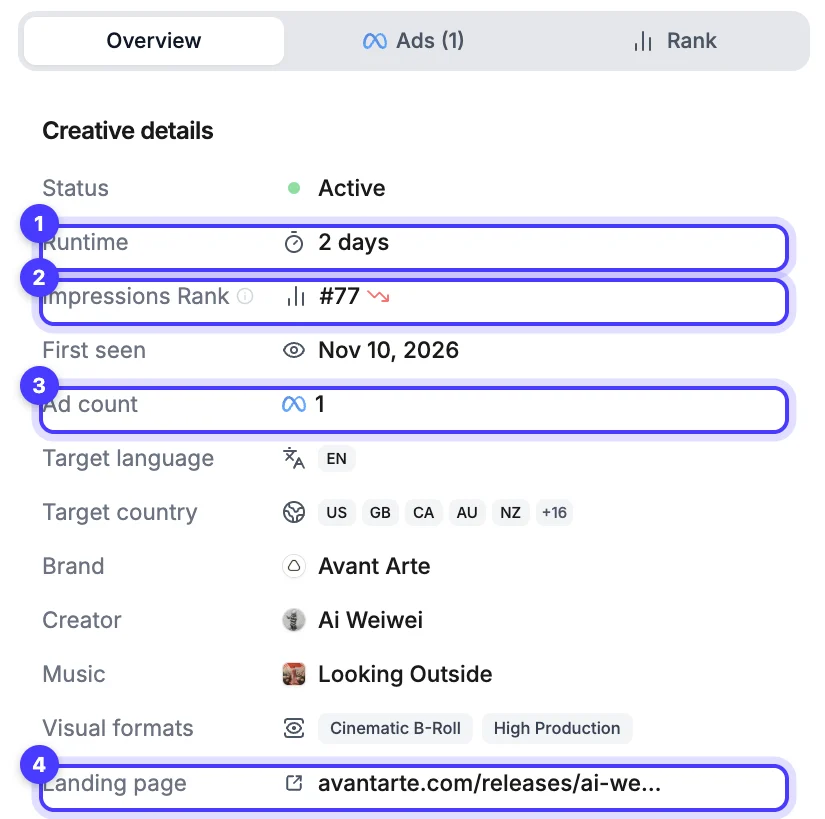
Useful weekly rather than daily: visual format tags (talking head, UGC, before and after, us vs them), the hook field, creator and influencer details, music, and the landing pages behind each creative. Landing pages help when we plan a cold traffic landing page.
Adspo pricing in US dollars, and how the free trial works
Adspo lists one plan, Pro, plus paid seats for extra team members. Prices are in US dollars. The Australian dollar figures below are rough conversions at the Reserve Bank's rate of US$0.6841 to the Australian dollar on 12 November 2026.
| Billed monthly | Billed yearly | |
|---|---|---|
| Pro, first seat | US$29 a month (about A$42) | US$19 a month, US$228 a year (about A$333 a year) |
| Each extra team seat | US$15 a month (about A$22) | US$10 a month (about A$15) |
| Free trial | 7 days | 14 days |
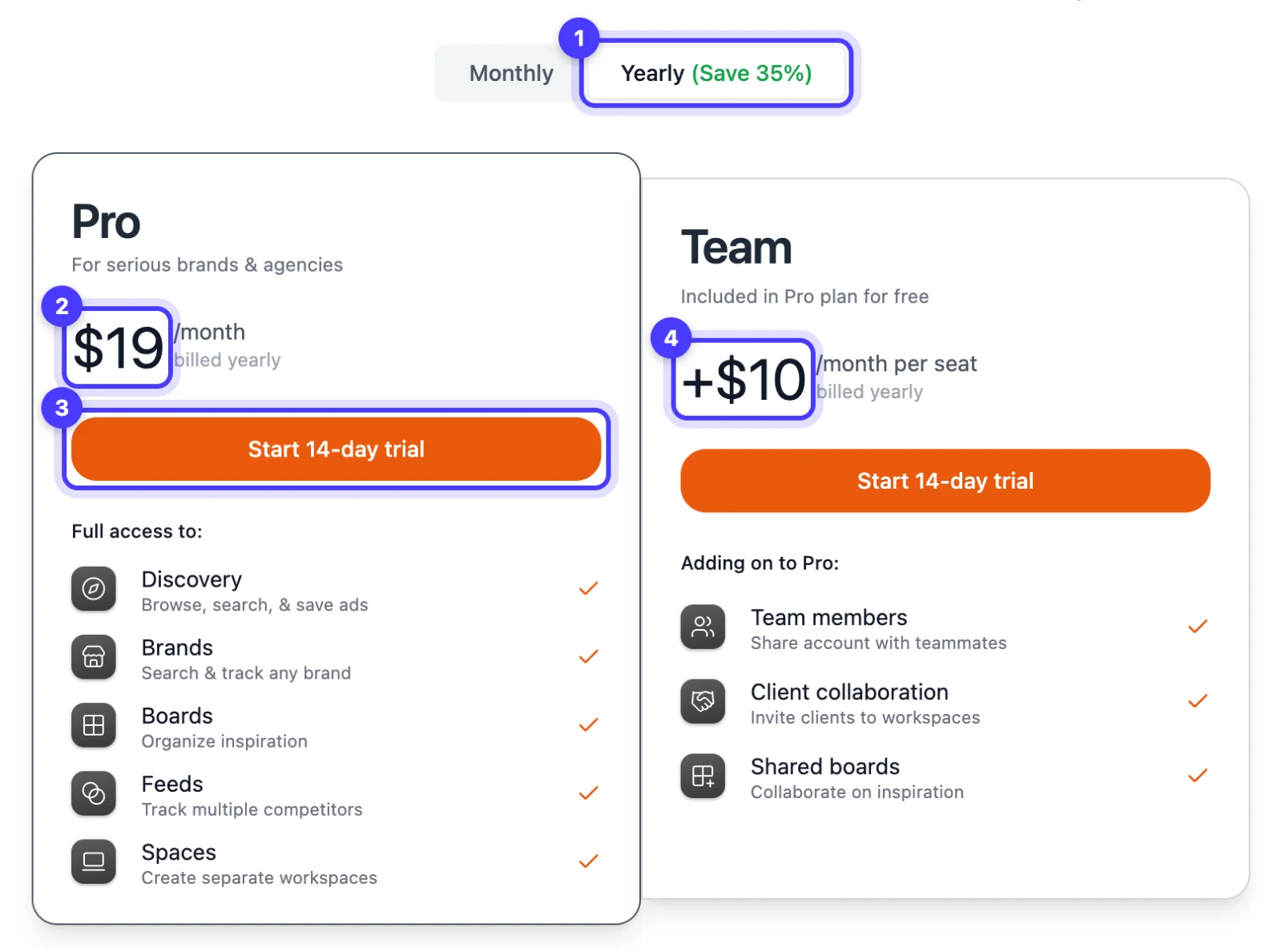
Pro includes unlimited brand tracking, boards, spaces, client invitations, AI search, and MCP and API access. Adspo offers a 7-day money-back guarantee, and you cancel from account settings with no cancellation fee.
Worked example: an in-house marketer plus one freelancer on yearly billing pay US$228 for Pro and US$120 for the second seat, US$348 a year (about A$509). People who only need to look at boards, such as a founder approving briefs, can use share links instead of seats.
To start an Adspo trial, choose monthly for 7 days or yearly for 14. Payment is needed to continue once the trial ends, and a yearly plan is billed for the full year. Cancelling switches the account off straight away, so download any boards you want to keep before you cancel. The 14-day trial covers two weekly briefing cycles, which is enough to judge it.
Adspo vs the free Meta Ad Library
The Meta Ad Library is free, holds every active ad shown across Meta's apps, and anyone can search it without logging in. It is the record of whether an ad is live right now. Adspo draws on the same Meta ads and adds the history, search and organisation an agency needs.
| Meta Ad Library | Adspo | |
|---|---|---|
| Cost | Free | US$29 a month, or US$19 a month billed yearly |
| Coverage | Every active ad from every advertiser | Meta ads from 10,000+ verified brands, weighted to ecommerce and DTC |
| Ads that have stopped | Kept only for political and social issue ads (7 years) and ads delivered to the UK or EU (1 year after the last impression) | Every creative keeps its lifespan from launch to turn-off |
| How an ad appears | One card per creative and text combination, so a video run with three versions of copy appears three times | Each unique image or video once, with connected ads grouped |
| Search and filters | Keyword or advertiser by country; filters for language, advertiser, platform, media type, active status and impressions by date | AI search across ads, brands, copy and transcripts; filters for industry, runtime, status and target country; browse by visual format |
| Delivery signal | Start date for Australian commercial ads; reach for ads delivered to the UK and EU; spend for political and social issue ads | Impressions rank within the brand's account, with history |
| Transcripts and hooks | None | Transcript, hook, copy, music and creator details |
| Saving and sharing | Download searches when logged in | Boards, downloads and public share links |
| Tracking brands | Search again by hand | Follow brands, with alerts for new ads, scaling creatives and funnel changes |
| Programmatic access | Ad Library API, limited to political and social issue ads and ads delivered to the EU | API, plus an MCP server for Claude, ChatGPT, Gemini, Cursor and Perplexity |
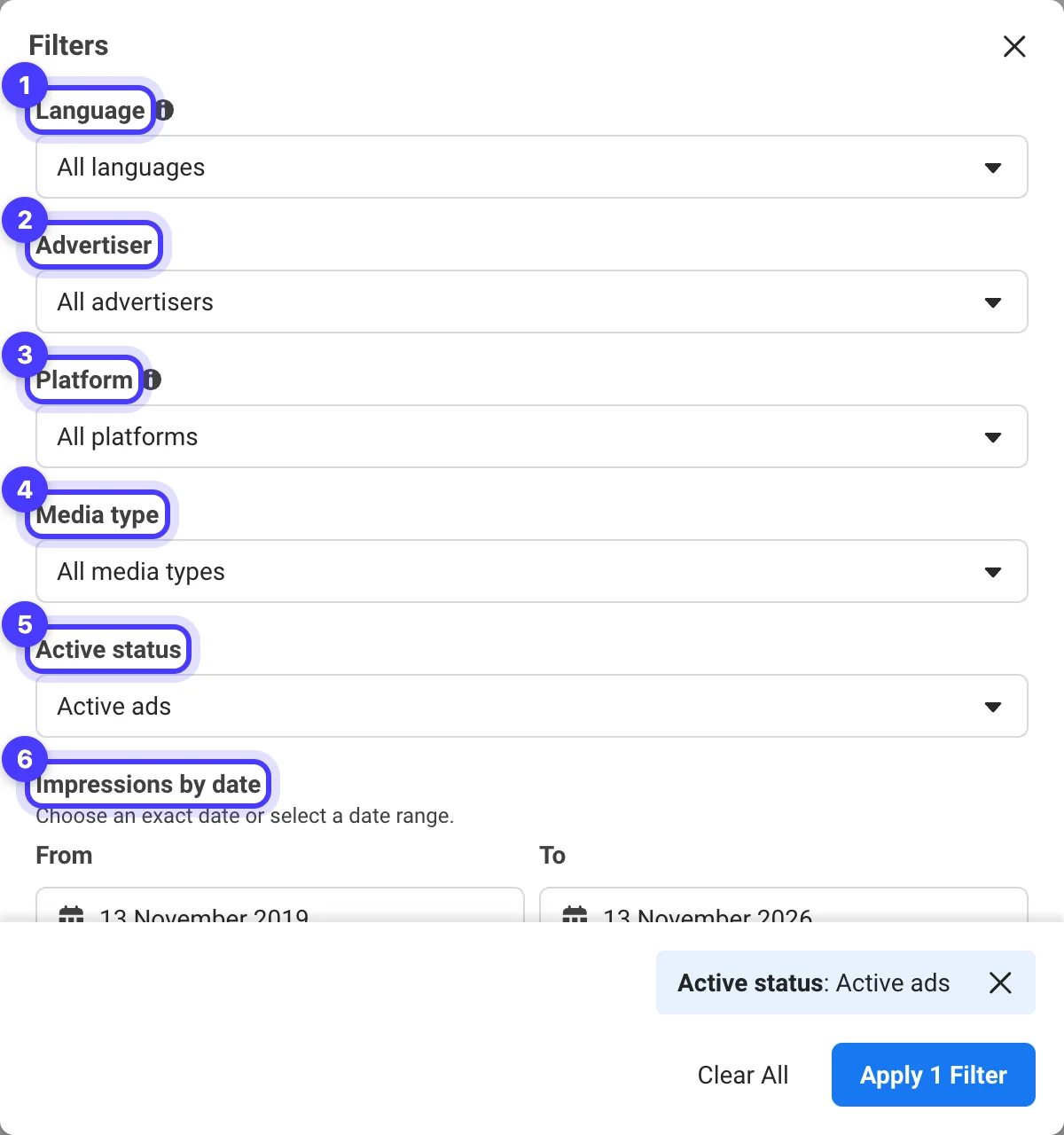
The free Library is enough when you need one competitor's live ads, want to confirm an ad is still running, research a local trade or service category, or look at political and social issue ads. We also use it as the second check on anything we find in Adspo. Our guide to using the Meta Ad Library in Australia shows how to search it properly. Adspo is worth paying for when research is weekly, spans many brands and has to be shared. Other paid tools are compared in our Facebook Ad Library alternatives guide.
See the decisions behind real ads.
46 ad breakdowns and 17 landing pages, each with the next test it suggests.
Where Adspo falls short
- Meta only. It covers Facebook and Instagram ads. There are no Google, TikTok or YouTube ads, so research on those channels needs other tools.
- Thin outside ecommerce. The library is strongest in apparel, beauty, supplements, food and home goods. Local trade and service categories are thin or missing: we searched skip bins, rubbish removal, junk removal and plant hire by name and by domain and found nothing. For those clients we work the Meta Ad Library directly.
- Impressions rank is relative. Rank 1 is the most-served creative within one brand's account. You cannot compare ranks across brands, and rank measures delivery, never spend or profit.
- No sales data. Like every ad library, it shows what brands run. Their sales, ROAS and budgets stay private. Runtime alone can mislead: an ad can stay live because it is cheap retargeting, brand activity in a small market, or simply forgotten.
- Transcripts need a human check. Search leans on transcripts and copy, and a transcript can be attached to the wrong video. Watch the creative before it goes on a board.
Start the trial and set up a useful first workspace in an hour
- Minutes 0 to 5: sign up. Start an Adspo trial, choose monthly or yearly, and log in at app.adspo.co.
- 5 to 15: create a space for the brand. If you run several brands or clients, give each its own space from day one, because followed brands and boards are kept separate per space.
- 15 to 25: follow 8 to 12 brands. Direct competitors first, then adjacent brands selling to the same customer in another category. Following them gives you alerts for new ads, scaling creatives and funnel changes.
- 25 to 40: build one persona board. Pick the persona with the clearest pain point. Search that problem, sort by longest running and then by newest, and save ads that show the matching moment until you have 20 distinct ones, no more than two of them yours. Our ad swipe file guide covers how we structure boards.
- 40 to 50: read each competitor's top creatives. Open each followed brand, look at its highest-ranked creatives by impressions and note which recent ones are climbing. Our guide to finding winning Facebook ads shows how to read those signals without mistaking runtime for profit.
- 50 to 60: share and connect. Copy the board's share link for whoever approves briefs. If you use Claude, add Adspo as a custom connector: go to Customize, then Connectors, click Add, choose Add custom connector and paste https://mcp.adspo.co as the server URL. Claude's Free plan allows one custom connector, and on Team and Enterprise plans an owner adds it in Organization settings first.
From a saved ad to a brief: take the pattern, never the ad
Research earns its subscription only when it changes what you produce. We translate the pattern into the client's own brand, evidence and customer language, and never reproduce another brand's asset, claim or distinctive expression. Every save that reaches a brief goes through six fields:
- Observed pattern: what repeats across the references.
- Customer tension: why it may matter to this persona.
- Our hypothesis: what we expect to happen.
- Original execution: how we will express it without copying.
- Proof: what makes it credible for this brand.
- Decision metric: the commercial result that decides it.
Longevity, ad count and apparent scale are research signals. They tell you what is worth testing, and the test decides. Step 5 of our Meta ads strategy for 2026 places this research in the full plan, the weekly paid creative system turns briefs into tests every week, and the creative testing pipeline planner sets how many concepts your budget can fund. If you would rather hand the research, briefs and production to us, that is the work behind our Meta ads management and monthly creative production.
Questions we get about Adspo
What is Adspo?
Adspo is a Meta ad research tool at adspo.co, made by Adspo Pty Ltd, an Australian company. It tracks Facebook and Instagram ads from more than 10,000 verified brands at the creative level, with each creative's runtime, copy, transcript, landing pages and impressions rank. You can follow brands, save ads to boards and keep each client's research in its own workspace.
How much does Adspo cost?
Adspo Pro costs US$29 a month billed monthly, or US$19 a month billed yearly (US$228 a year). Extra team seats cost US$15 a month, or US$10 a month on yearly billing. At the Reserve Bank rate on 12 November 2026, US$29 is about A$42.
Does Adspo have a free trial?
Yes. Monthly plans start with a 7-day free trial and yearly plans with a 14-day free trial, and Adspo offers a 7-day money-back guarantee. You cancel from account settings, and the account switches off as soon as you cancel, so download any boards you want to keep first.
Is Adspo worth it?
For an ecommerce or DTC brand, or an agency, briefing Meta creative every week, yes. We use it daily across more than 20 client workspaces. For a local trade or service business, or research once a quarter, the free Meta Ad Library does the job.
What is the difference between Adspo and the Facebook Ad Library?
The Meta Ad Library is free and shows every active ad, with a new card whenever the copy changes, but keeps stopped commercial ads only when they delivered to the UK or EU. Adspo groups ads by creative, keeps each creative's lifespan, and adds transcripts, impressions rank, brand alerts and shareable boards.
Does Adspo show TikTok or Google ads?
No. Adspo covers Meta ads on Facebook and Instagram. Research on TikTok, Google or YouTube ads needs other tools.
Sources
- Adspo: Pricing
- Adspo: product and pricing summary (llms.txt)
- Adspo: Terms of Service
- Meta Business Help Centre: About the Meta Ad Library
- Meta Transparency Center: Ad Library tools
- Claude Help Center: Get started with custom connectors using remote MCP
Disclosure: Hey Sage uses Adspo for client work and earns a referral fee when you subscribe through our Adspo links.