
On this page
- 01 · The signals that a Facebook ad is working, in the order we weight them
- 02 · Why the longest-running ad is often the wrong reference
- 03 · Finding winning ads in the free Meta Ad Library, step by step
- 04 · The faster method in Adspo
- 05 · How to read one winning ad properly
- 06 · What to take from a winning ad: the pattern, never the ad
- 07 · Questions we get about finding winning Facebook ads
- 08 · Sources
The signals that a Facebook ad is working, in the order we weight them
You cannot see another brand's sales, spend or ROAS, so a winning Facebook ad is one the brand keeps paying to show. We look for five signals, in this order: a creative that keeps running while the brand launches new ones around it; the same concept relaunched or rebuilt in new formats; many versions of one creative live at once; a high impressions rank within the brand's own account that holds or rises; and the same creative running across the brand's markets. One signal is a lead. Three or more on the same creative make it a reference worth briefing from.
- Survival among new launches. The brand keeps adding new creatives and this one stays on, so it keeps beating fresh challengers. An old ad in an account that never changes tells you far less.
- Relaunches and rebuilds. The same idea comes back with a new start date, a new edit, a 9:16 cut for Reels or a static version of a video. Brands rebuild what pays them.
- Versions live at once. Several ads use the same image or video at the same time.
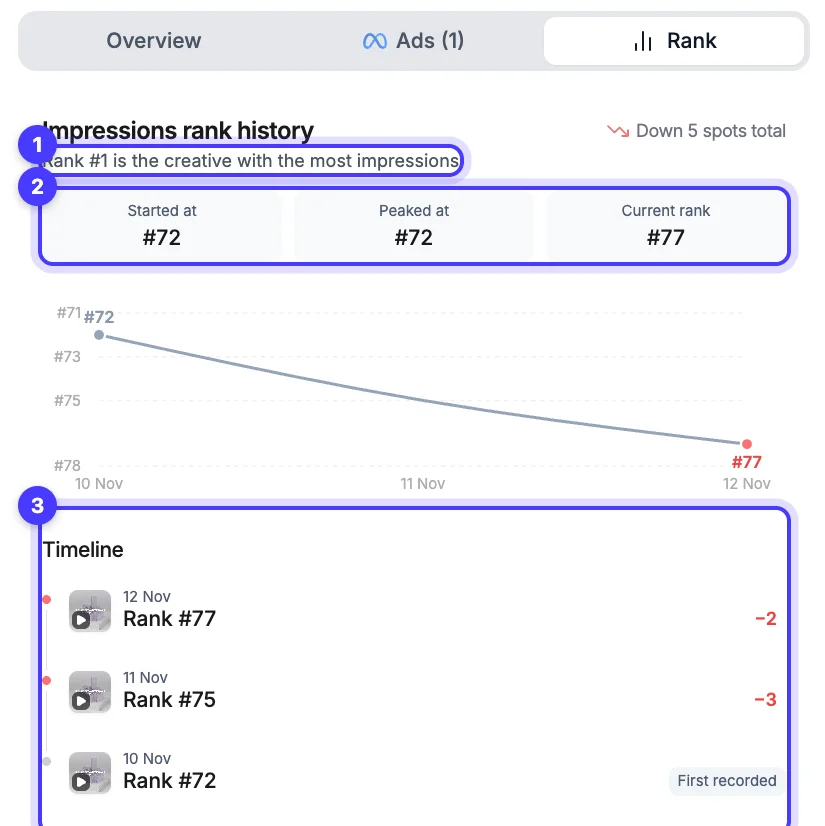
- Impressions rank that holds or rises. In Adspo each creative carries a rank within the brand's own account, where rank 1 is its most-served creative, plus a history over time. A creative near the top for weeks is being fed budget.
- Consistency across markets. The creative runs in Australia and in the brand's other markets, such as New Zealand, the UK or the US.
The first two are decisions the brand made after seeing its own results, which is as close as you get to their numbers. Versions and impressions rank show where the money is going now, and markets confirm it. Runtime is missing on purpose: everyone sorts by it, and it misleads most often.
Why the longest-running ad is often the wrong reference
Runtime alone can mislead. For an ordinary ad in Australia the free Meta Ad Library shows a start date and nothing about spend, impressions or reach (apart from a Low impression count label on ads that have barely run), so age is tempting to treat as proof. Ads stay live for months for other reasons:
- Retargeting. A cheap ad shown to recent site visitors can run for a year on a few dollars a day, persuading people who were already close to buying.
- Brand activity. An always-on brand video is judged on reach and recall, not sales.
- Small markets. An ad running in one city or one small country can stay on at low spend indefinitely.
- Forgotten ads. Plenty of accounts have an ad set nobody has opened in a year, still spending a trickle.
- Evergreen offers. A standing free shipping or first-order discount ad stays live because the offer never changes.
So runtime builds the shortlist and the other signals decide. Here is how that plays out on three ads from one brand.
Worked example: scoring three ads from one brand
Ads A, B and C are invented for this worked example. Each signal scores one point.
| Signal | Ad A | Ad B | Ad C |
|---|---|---|---|
| Runtime (shortlist only, not scored) | 14 months | 5 months | 3 weeks |
| Kept running while new ads launched around it | Yes, about 80 launched | Yes, about 60 launched | Too early to tell |
| Relaunched or rebuilt in new formats | No | Yes: relaunched twice, plus a 9:16 cut and a static | No |
| Versions live at once | 1 | 6 | 4 |
| Impressions rank in the brand's account | #38 and falling | #2, held for 10 weeks | #1 and rising |
| Markets | Australia only | Australia, New Zealand, UK | Australia only |
| Score | 1 of 5 | 5 of 5 | 2 of 5 |
| What we do | Ignore: probably retargeting or forgotten | Brief from it | Check again in a month |
Sorted by runtime, Ad A comes first, and it is the weakest reference of the three: it survived, but Meta barely serves it and nothing else shows the brand backing it. Ad B is the one to learn from. Ad C is the brand's newest push. It could become the next Ad B or be a sale that ends next week, and a month tells you which.

Run Better Ads. The free guide + vault.
137 pages on ecommerce ads, with 46 real ads and 17 landing pages taken apart.
Finding winning ads in the free Meta Ad Library, step by step
The Meta Ad Library is free, needs no Facebook account and holds every active ad across Facebook, Instagram and Meta's other apps. For checking one or two brands it is enough. Our guide to the Meta Ad Library in Australia covers everything it shows; this is our routine for finding winners in it.
- Open facebook.com/ads/library, set the location to Australia and the ad category to All ads, then type the brand's name and pick its Page from the drop-down to see its active ads.
- Open Filters. Leave Active status on Active ads. Set Media type to Videos or Images to study one format. The other filters are Language, Advertiser, Platform and Impressions by date.
- Use Sort by. The two options are Impressions: high to low, the default, and Most recent. There is no runtime or oldest-first sort, so long runners sit at the bottom of Most recent. The impressions sort gives an order with no figures attached.
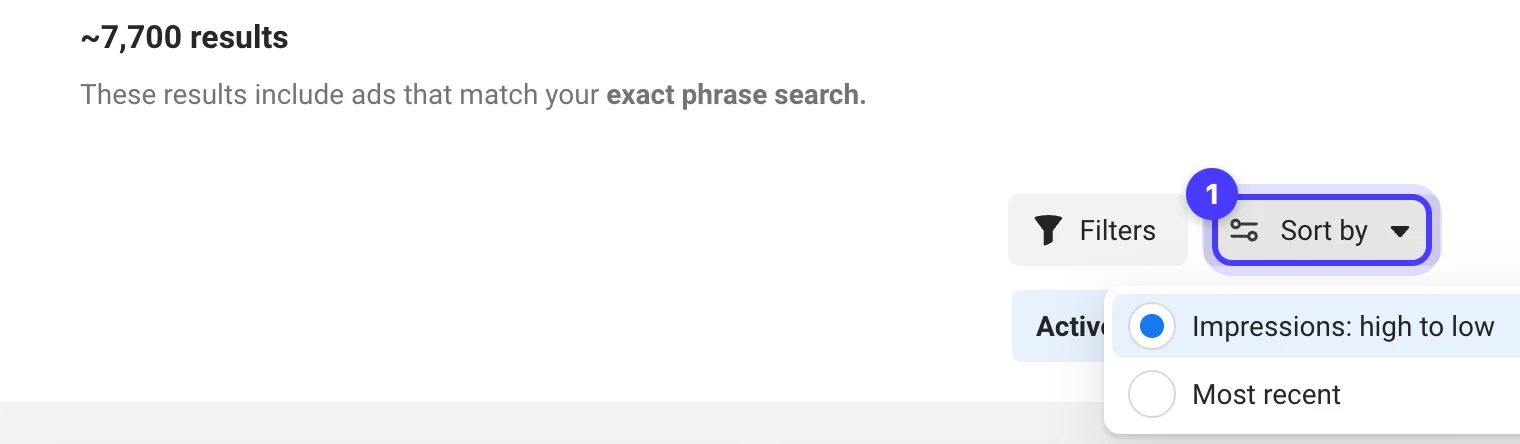
Sort by menu on an Ad Library search: open it (1) and choose between Impressions: high to low, the default, and Most recent. There is no option to sort by runtime. - Read Started running on on each card and count to today. For ordinary ads in Australia it is the only date Meta shows. There is no end date, because the ad drops out of the library when it stops.
- Look for a card that says 6 ads use this creative and text (or any number), then open See summary details. Meta groups ads that share an image or video and text, which advertisers use to run campaigns with different start dates, locations or budgets. That is signal three, and the start dates inside the group show relaunches (signal two).
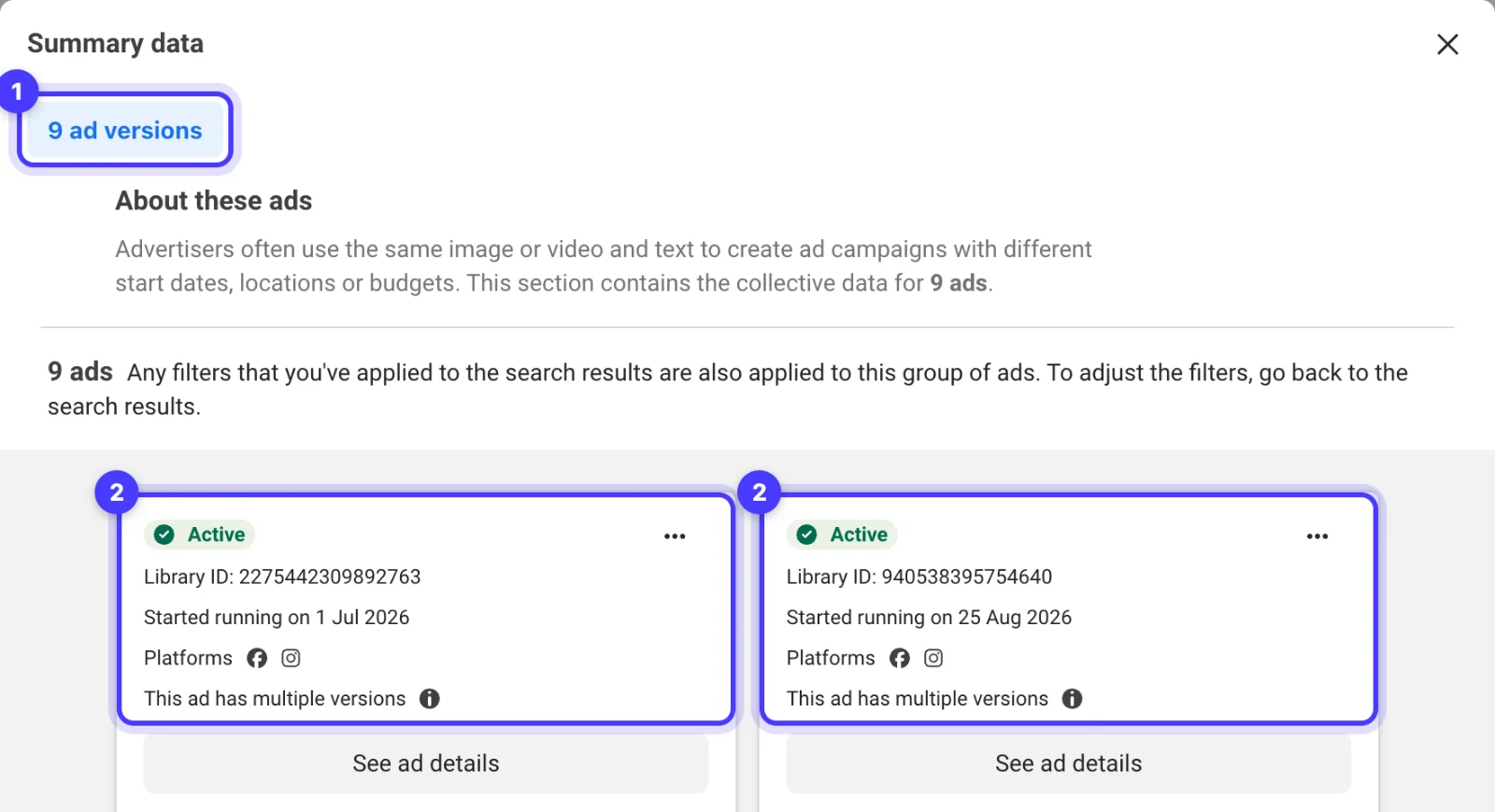
Summary data, opened from a card that read 9 ads use this creative and text: 1 is the size of the group, and each ad in it (2) carries its own Library ID and start date. Different start dates on one creative mean the brand launched it again. - Note the labels. This ad has multiple versions marks one ad serving several versions, and the card can show a different one each time you load it. Low impression count (fewer than 100 impressions) turns up mostly on brand-new launches in the Most recent view.
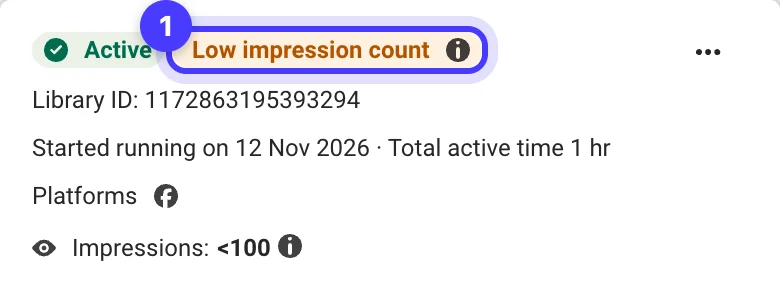
Ad card in the Most recent view: Low impression count (1) sits beside Active while the ad has had fewer than 100 impressions, as the bottom line shows. This one had been live for an hour. - Check other markets. Change the location to New Zealand, the United Kingdom or the United States and search the brand again. For ads that reached the UK or the EU, Meta shows total reach and keeps the ad for a year after its last impression, so set Active status to Active and inactive there to see what the brand switched off.
New ads appear within 24 hours of their first impression, so a weekly pass catches every launch. Where the library falls short: it groups ads only when both creative and text match, so one video run with several captions shows as several cards; an Australian-only ad leaves no history once it stops; and you never see delivery for ordinary ads. For local trades and services it is still where we do this work, because Adspo barely covers them.
The faster method in Adspo
We use Adspo every day for client research because it answers the five signals directly. Built by an Australian company, it holds Meta ads (Facebook and Instagram) from 10,000+ verified brands and tracks them at the creative level: each unique image or video appears once, with its lifespan from launch to turn-off, instead of one card per copy variation.
- Filter target country to Australia, set status to active and sort by longest running. That is your runtime shortlist in one view. Switch status to inactive to see what brands ran and stopped, with the full lifespan.
- Sort by most ads (total ad count) to find the creatives a brand has put into the most ads (signal three).
- Open a creative and read its impressions rank and impression history. Rank 1 is the brand's most-served creative. A creative that holds a top rank for weeks, or climbs, is being fed budget (signal four). Follow the brand and Adspo alerts you when a creative starts scaling.
- Check the creative's target countries for signal five, and its connected ads and landing pages for how the brand is using it.
- Browse by visual format (talking head, UGC, before and after, us vs them) when you want winners in a style rather than from one brand, and search ad copy and transcripts to find ads about your customer's problem.
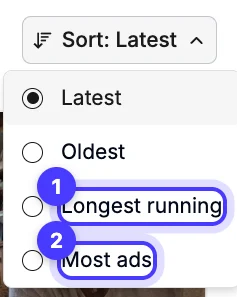
Each client brand we manage has its own Adspo space with its competitors and adjacent brands followed. When browsing competitors stops producing matches, we search the audience's problem across copy, transcripts and image text, use industry filters to cut unrelated meanings, then run an unfiltered pass before deciding nothing exists. The first screen of results is never the full set: scroll, and try another sort. We also run this discovery through the Adspo connector in Claude, covered in our guide to researching ads with Claude.
Pro costs US$29 a month billed monthly or US$19 a month billed yearly (US dollars), with a 7-day free trial on monthly and 14 days on yearly, so an Adspo trial covers a full research sprint. Know the limits first. It covers Meta only, with no Google, TikTok or YouTube ads. The library leans to ecommerce and DTC brands: we searched skip bins, rubbish removal, junk removal and plant hire and found nothing. And impressions rank is relative within one brand's account, so rank 1 at a small brand and rank 1 at a large one are very different amounts of spend. Our Adspo review covers the rest, and how to see competitors' Facebook ads covers tracking a full competitor set.
See the decisions behind real ads.
46 ad breakdowns and 17 landing pages, each with the next test it suggests.
How to read one winning ad properly
Once a creative scores three or more, take it apart before anyone opens an editor. We write one line for each part:
| Part | What to note | The question it answers |
|---|---|---|
| Hook | The first line of copy, the first two or three seconds of video, the on-screen text. Read the transcript, then watch the video, because transcripts can be mismatched. | Who does it stop, and with what tension? |
| Offer | What it asks for and the deal: price, bundle, trial, guarantee, shipping. | Why act now? |
| Proof | Reviews, demonstration, before and after, expert, founder, numbers. | Why believe it? |
| Format | Talking head, UGC, demo, static or carousel; aspect ratio, length and captions. | How does the idea survive a scroll? |
| Landing page | Product page, collection, listicle, quiz or a page built for the ad; whether its headline continues the ad's promise. | What happens after the click? |
The landing page is the part most people skip. Click through from the ad and note where it lands, because the pairing is part of what is working. Our guide to cold traffic landing pages covers what that page needs to do.
What to take from a winning ad: the pattern, never the ad
Copying a winning ad gets you someone else's brand and claims and none of the proof behind their results. Take the pattern and translate it into your own brand, evidence and customer language, without reproducing another brand's footage, claim or distinctive wording. We turn every reference into a test with six lines:
| Line | What goes in | Worked example, for a cleaning product |
|---|---|---|
| Observed pattern | What the winner does, written without the brand's name | The problem on camera in the first two seconds, the fix in one unbroken shot, the offer as on-screen text at the end |
| Customer tension | The pain in your customers' own words, from reviews, emails and sales calls | Buyers doubt any spray can lift an old stain |
| Our hypothesis | Why this pattern should work for your customer | An uncut demonstration on a real old stain will beat our studio product video with cold audiences |
| Original execution | Your product, your people, your words | A customer's own stain at home, filmed vertically on a phone, with our offer |
| Proof | The evidence you can stand behind | The uncut take itself, plus our review count on screen |
| Decision metric | The number that decides, set before launch | Cost per purchase against our current best ad at equal spend |
For each client persona (a specific situation and pain point, not a demographic) we keep a board of 20 distinct ads, no more than two from the client's own brand, and every ad has to show the moment that hits that pain: the overlay, voiceover line or demonstration. The same footage with a lightly changed hook counts once. The boards sit in the client's Hey Sage portal next to each persona, so they see the references we brief from. How personas become ad sets is in our guide to persona ad sets, and how we keep references organised is in building an ad swipe file.
From there the test joins the queue. The weekly paid creative system shows where it goes each week, and how many ad creatives to test sets the volume. If you would rather hand the research and the briefs to us, it is part of our Meta ads management work for Australian brands.
Questions we get about finding winning Facebook ads
How do you know if a Facebook ad is winning?
You cannot see its sales, so judge it by what the brand does with it: a creative that outlives new launches, comes back in new formats, runs in several versions at once, holds a high impressions rank within the brand's account and runs across the brand's markets. Three or more of those on one creative make it worth studying.
How can I see how long a Facebook ad has been running?
Find the ad in the Meta Ad Library and read Started running on, then count to today. For ordinary ads in Australia Meta shows only the start date, and the ad drops out of the library when it stops unless it also ran in the UK or EU. Adspo shows each creative's lifespan from launch to turn-off, including creatives that have stopped.
How do I find the longest running Facebook ads?
In Adspo, filter target country to Australia and sort by longest running. The free Meta Ad Library has no runtime sort: its Sort by options are Impressions: high to low and Most recent, so you scroll and read start dates. Then check the other signals, because the longest runner is often retargeting or an ad nobody switched off.
Where can I find winning Facebook ad examples?
Start with your competitors and adjacent categories in the Meta Ad Library, one brand at a time, or use an ad library such as Adspo that groups ads by creative and sorts across brands. Search your customer's problem as well as your product, because another category often shows the same pain being solved.
Can I see how much a competitor spends on Facebook ads?
No. For ordinary ads in Australia the Meta Ad Library shows no spend, impressions or reach beyond that Low impression count label. Spend and impression ranges appear only for ads about social issues, elections or politics, and reach for ads that delivered in the UK or EU. Adspo's impressions rank is relative within one brand's account and measures delivery, not spend or profit.
Should I copy a winning Facebook ad?
No. Take the pattern: the hook structure, the type of proof, the format and the offer logic, then build it from your own brand, evidence and customer language. Reproducing another brand's footage, claims or wording borrows their brand and none of the proof behind their results.
Sources
- Meta Business Help Centre: About the Meta Ad Library
- Meta Ad Library: search, filters, Sort by and summary details (checked 13 November 2026)
- Adspo: creative-level ad library, impressions rank, pricing
Disclosure: Hey Sage uses Adspo for client work and earns a referral fee when you subscribe through our Adspo links.