
On this page
- 01 · When the free Meta Ad Library is enough, and when to pay for an alternative
- 02 · What the free Meta Ad Library does well
- 03 · Where the free library falls short in weekly agency work
- 04 · What to check before you pay for any ad research tool
- 05 · The three kinds of tool sold as ad library alternatives
- 06 · Why we chose Adspo, and how we use it
- 07 · Free Meta Ad Library vs Adspo, job by job
- 08 · Where Adspo does not fit
- 09 · Questions we get about Facebook Ad Library alternatives
- 10 · Sources
When the free Meta Ad Library is enough, and when to pay for an alternative
Stay with the free Meta Ad Library if you check one or two competitors now and then, need political or social issue ads, or want the reach and targeting data Meta publishes for ads shown in the EU and UK. Pay for an ad research tool once you track several brands every week, need ads that have already stopped, want to find ads by the problem they solve or the format they use across many brands, or have to save and share references with a team or clients. Whatever you buy should keep stopped ads, show each creative once, carry transcripts and landing pages, and cost less than the hours it saves.
We use Adspo for that work across more than 20 client workspaces, and still open the free library most days. Adspo keeps every Meta creative it tracks with its lifespan from launch to turn-off, follows the brands we care about with alerts when they launch or scale something, and lets us share boards with clients who have no account. It covers Meta only and is thin on local trades and services, so for those clients the free library stays our main tool.
What the free Meta Ad Library does well
The library is Meta's own transparency tool. It holds every active ad shown across Meta's apps, from every advertiser, and anyone can search it without logging in. No paid tool covers more of what is live on Facebook and Instagram today.
- Search and sort. Search by keyword or advertiser, country by country; filter by language, advertiser, platform, media type, active status and impressions by date; sort by Impressions: high to low or Most recent. Australian commercial ads show no impression figures beyond a Low impression count label on ads that have barely run, but that sort puts the most-served ads first.
- Grouping and links. Separate ads that reuse the same creative and text are grouped ("6 ads use this creative and text"), and every card has Copy Ad Link, which we paste into briefs.
- Political and social issue ads stay visible for seven years, active or inactive, with ranges for spend and impressions and the disclaimer showing who paid.
- Ads delivered to the EU or UK are archived for a year after their last impression, with the dates they ran, age, gender and location targeting, and reach.
- Downloads. Logged in to Facebook, you can download a search.
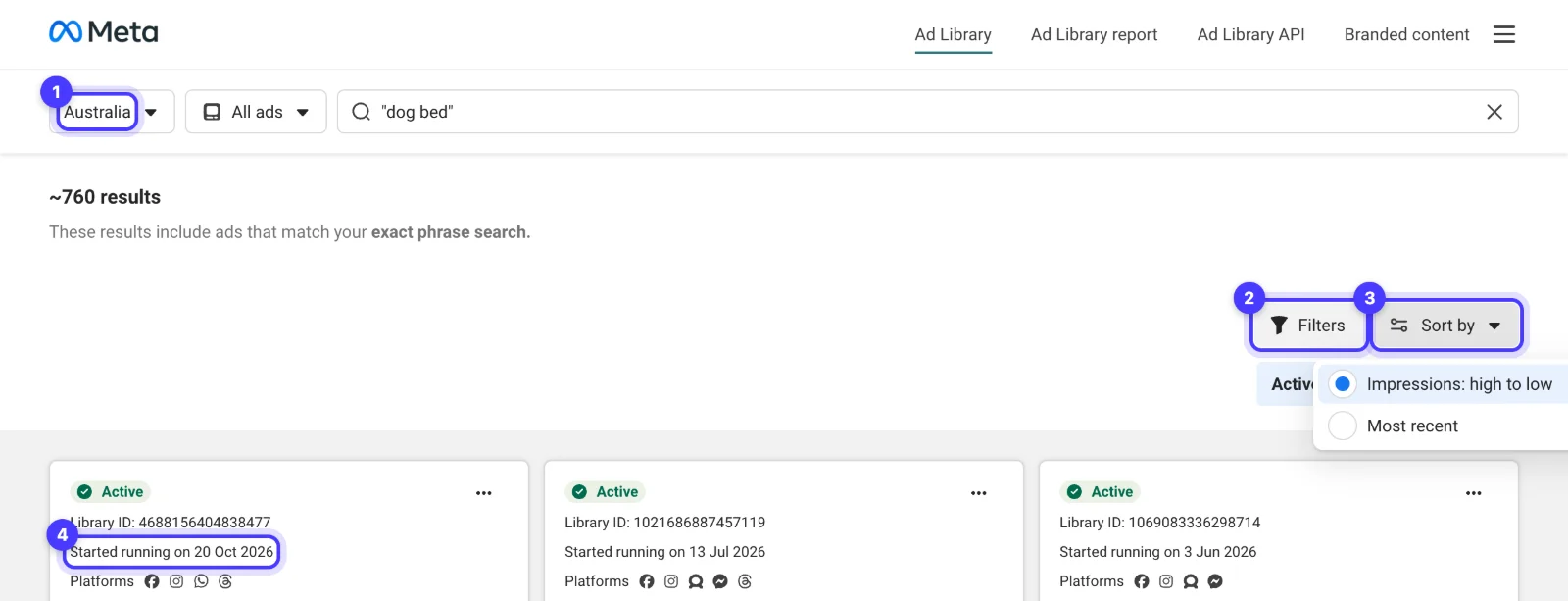
For a quick look at one competitor's live ads in Australia, or a check that an ad is still running, the free library is all you need. Our guide to using the Meta Ad Library in Australia covers every search mode, filter and card label.

Run Better Ads. The free guide + vault.
137 pages on ecommerce ads, with 46 real ads and 17 landing pages taken apart.
Where the free library falls short in weekly agency work
- Stopped ads disappear. Meta keeps inactive ads only when they are about social issues, elections or politics, or were delivered to the EU or UK. An Australian brand that advertises only in Australia leaves no record: its sale ads from last November are gone once they stop.
- The same footage appears many times. Meta groups ads only when the creative and the text both match. A brand testing one video with five captions fills five cards.
- Nothing to save to. Each card offers Copy Ad Link and nothing more: no boards, tags, notes or share pages.
- No alerts. Nothing tells you when a competitor launches or scales an ad. You run the search again and compare it with last week by eye.
- Discovery stops at words. Search matches words in ads and advertiser names. There is no industry filter and no way to browse by format, such as talking head or before and after.
- No script and no landing page. The card shows the copy, the video and the link's domain. To get a video's script you watch it, and to see the landing page you click through while the ad is still live.
- No delivery figures for Australian commercial ads. You get a start date and a sort order, never impressions, reach or spend, apart from a Low impression count label (under 100) on ads that have barely run.
Worked example: a marketer tracking eight competitors in the free library spends Monday morning running eight searches, scrolling past repeats, and checking last week's screenshots to spot what is new. Any ad that stopped in between has gone. A tool that follows those eight brands shows new creatives in one feed and keeps the stopped ones. Our guide to seeing a competitor's Facebook ads walks through both routes.
What to check before you pay for any ad research tool
Run every tool you trial through the same list. You can test most of it in the first hour.
- Coverage. Which networks it covers (Meta, TikTok, Google, YouTube) and which brands it holds. Search five competitors and two adjacent brands by name and by domain before you judge anything else. If your category is missing, stop there.
- Deduplication. Whether each image or video appears once or as one card per ad.
- History. Whether it keeps ads after they stop, with launch and turn-off dates, and how far back its records go for Australian brands.
- Search fields and filters. Copy, transcripts, on-image text and brand names; filters for industry, format, country, runtime and status.
- Delivery signal. What the tool ranks ads by. A rank inside one brand's account, a runtime and an ad count all measure delivery, never sales.
- Tracking limits and alerts. How many brands your plan lets you follow, and whether it alerts you to new ads, scaling creatives or landing page changes.
- Saving and sharing. Boards, downloads, and share links a client can open without an account.
- Seats and client spaces. The price of each extra team member, and whether each client gets a separate workspace you can invite them into.
- API or MCP access. If you research with Claude or another AI assistant, check for an MCP connector. Our guide to using Claude for ad library research shows the workflow.
- Price and terms. The currency you are billed in, monthly against yearly, trial length, refund terms, and what happens to your boards if you cancel.
The three kinds of tool sold as ad library alternatives
Searches for "best ad spy tool" mix products that answer different questions. Know yours before you compare prices.
Ad libraries and spy tools: other brands' ads
These index other brands' ads, mostly from Meta. The better ones add history after an ad stops, one card per creative, transcripts, cross-brand search, boards and alerts. Buy one when the question is what competitors and adjacent categories run and keep running. Coverage decides whether one is any use to you.
Creative analytics: your own ads
These connect to your own ad account and report on your own creatives: which hooks hold attention, which concepts win spend, when an ad starts to tire. They answer how your ads perform, from your data. If your problem is reading your own results, look here, and pair it with a testing routine like our weekly paid creative system.
Free platform libraries for other channels
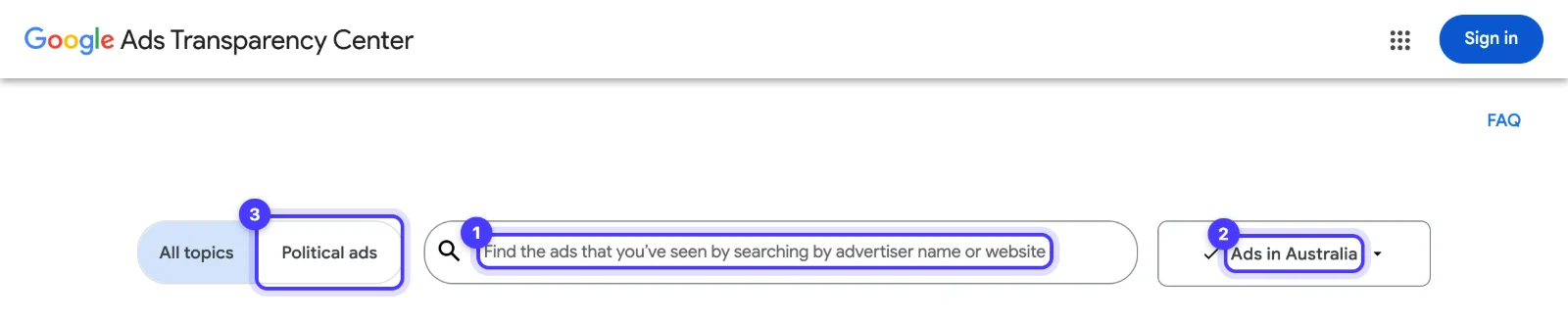
For TikTok, the TikTok Creative Center is free and public. Its Top Ads section collects high-performing creatives from TikTok, its Trends section shows trending hashtags, and you can browse without logging in, though signing in opens more data. For Google Search, Display, Gmail and YouTube ads, Google's Ads Transparency Center is a searchable record of advertisers and the ads they have served. Meta-only tools, Adspo included, cover neither, so a brand spending heavily on TikTok or YouTube needs these as well.
Why we chose Adspo, and how we use it
The features we rely on every week, in the order they matter to us:
- One card per creative. Adspo tracks at the creative level: each unique image or video appears once, with its lifespan from launch to turn-off and its connected ads grouped under it. A brand's account reads as a list of concepts.
- Lifespan and impressions rank. Each creative shows launch date, runtime, target countries and an impressions rank within the brand's account (rank 1 is its most-served creative) with history, which shows what a brand is pushing right now.
- Search by problem and format. Search runs across ads, brands, ad copy and transcripts, and you can browse by visual format such as talking head, UGC, before and after, or us vs them. When competitors run dry, we search the customer's problem, use industry filters to cut unrelated meanings, then run an unfiltered pass before deciding nothing exists.
- A space per client. We keep one workspace per client brand, more than 20 of them, each following that brand's competitors and adjacent brands, with boards per theme or month.
- Boards clients can open. For each client persona we curate a board of 20 distinct ads, no more than two from the client's own brand, and every ad has to show the moment that hits that persona's pain. Public share links need no account, so we embed those boards in each client's portal next to the persona they belong to. How we build and prune them is in our ad swipe file guide.
- MCP in Claude. Adspo has an MCP server and an API. We use the connector inside Claude to search by topic, filter by format, read full copy and transcripts, and check what is on a board before we brief.
- Price. Pro is US$29 a month billed monthly or US$19 a month billed yearly (US dollars), with unlimited brand tracking. Extra team members are US$15 a seat a month, or US$10 billed yearly. The trial runs 7 days on monthly billing and 14 on yearly, with a 7-day money-back guarantee.
If your research sits on the paid side of the line, start an Adspo trial on yearly billing and run the checklist against your own competitors in the 14 days. Our Adspo review covers setup and how a saved ad becomes a brief.
See the decisions behind real ads.
46 ad breakdowns and 17 landing pages, each with the next test it suggests.
Free Meta Ad Library vs Adspo, job by job
| Job | Free Meta Ad Library | Adspo |
|---|---|---|
| See everything a brand is running today | Every active ad from every advertiser, free, no login | Meta ads from 10,000+ verified brands, weighted to ecommerce and DTC |
| See what a brand ran last Black Friday | Gone, unless the ad was political or delivered to the EU or UK | Each tracked creative keeps its launch date and lifespan |
| Count a brand's distinct concepts | Ads grouped only when creative and text both match | Each unique image or video once, connected ads grouped |
| Find ads by problem or format across brands | Keyword or advertiser search; filters for language, advertiser, platform, media type, status and impressions by date | Search across copy and transcripts; filters for industry, runtime, status and target country; visual format tags |
| Tell which ads get the most delivery | Sort by Impressions: high to low, with no figures for Australian commercial ads | Impressions rank within the brand's account, with history |
| Read a video's script and see the landing page | Watch the video, click through while the ad is live | Transcript, hook, landing pages, music and creator details |
| Hear about a competitor's new ads | Search again by hand | Alerts for new ads, scaling creatives and funnel changes |
| Save and share references | Copy Ad Link; download searches when logged in | Boards, downloads, public share links that need no account |
| Keep clients separate | No workspaces or client access | A space per client, with client invites |
| Work from Claude or code | Ad Library API, covering political and social issue ads and ads delivered to the EU and UK | MCP server and API |
| Cost | Free | US$29 a month, or US$19 a month billed yearly (US dollars) |
We use both. Adspo does the tracking, discovery and sharing; the free library is our second check that an ad is still live, our source for political ads and EU and UK data, and our main tool for brands Adspo does not hold.
Where Adspo does not fit
- Meta only. It covers Facebook and Instagram ads. There are no Google, TikTok or YouTube ads.
- Thin on local trades and services. The library leans to ecommerce and direct-to-consumer brands. We searched skip bins, rubbish removal, junk removal and plant hire by name and by domain and found nothing. For clients in those categories we work the Meta Ad Library directly.
- Impressions rank is relative. It compares creatives inside one brand's account, so rank 1 at a small brand and rank 1 at a large one are different things, and neither tells you spend or profit.
- No sales data. Like every ad library, it shows what brands run, never their sales, ROAS or budget. Runtime alone can mislead: an ad can stay live because it is cheap retargeting, brand activity in a small market, or simply forgotten.
Whichever tool you use, take the pattern and leave the ad. We turn each saved reference into a test by writing down the observed pattern, the customer tension, our hypothesis, an original execution, the proof we will use and the metric that decides it. If you would rather hand the research and the ads to us, that is part of our Meta ads management.
Questions we get about Facebook Ad Library alternatives
What is the best alternative to the Facebook Ad Library?
For Meta ads, a curated ad library that keeps stopped ads, shows each creative once, and lets you follow brands and share boards. We use Adspo across more than 20 client workspaces. It covers Meta only: use the free TikTok Creative Center for TikTok and Google's Ads Transparency Center for Google and YouTube.
Is there a free alternative to the Meta Ad Library?
For Facebook and Instagram ads, the Meta Ad Library is the free source, and it holds every active ad. Paid tools add history, deduplication, saving and alerts. Adspo, priced in US dollars, has a free trial: 7 days on monthly billing and 14 on yearly.
What is the best ad spy tool for Facebook ads?
The one that holds your competitors. In the trial, search five competitors by name, check that stopped ads keep their dates and that each video appears once. For ecommerce and DTC brands we use Adspo; for local trades and services, the free Meta Ad Library.
Can you see inactive ads in the Meta Ad Library?
Only some. Ads about social issues, elections or politics stay for seven years, and ads delivered to the EU or UK are archived for one year after their last impression. Commercial ads that ran only in Australia drop out of the library once they stop.
Can an ad spy tool show a competitor's ad spend or ROAS?
No. Ad libraries show what brands run, never their sales, ROAS or budget. The Meta Ad Library shows spend ranges only for political and social issue ads. Adspo's impressions rank compares creatives within one brand's account, which is a delivery signal rather than a profit figure.
Sources
- Meta Business Help Centre: About the Meta Ad Library
- Instagram Help Centre: How do I view an account's active ads on Instagram?
- TikTok Ads Help Centre: Creative Center
- Google Ads Help: Ads transparency
- Adspo: features
- Adspo: pricing
Disclosure: Hey Sage uses Adspo for client work and earns a referral fee when you subscribe through our Adspo links.