
On this page
- 01 · How to do Facebook ad research that ends in a brief
- 02 · Step 1: write the research question before you open a library
- 03 · Step 2: map who to read (three rings, not one competitor list)
- 04 · Step 3: search by the buyer's problem, not the brand
- 05 · Step 4: read each ad for the pattern it uses
- 06 · Step 5: build a persona board of 20 distinct ads
- 07 · Step 6: turn the board into a brief and a test
- 08 · A worked example
- 09 · Free library or a paid tool?
- 10 · Questions we get about Facebook ad research
- 11 · Sources
How to do Facebook ad research that ends in a brief
Good Facebook ad research answers one question for one buyer, and it ends in a brief, not a folder of screenshots. Our process has six steps: write the question, map who to read, search by the buyer's problem, read each ad for its pattern, build a board of 20 distinct ads, then turn the patterns into a brief and a test.
The free Meta Ad Library is enough to do all six by hand. We do the searching and saving in Adspo because it adds transcripts, lifespans and boards, and it lets us run the same research across more than 20 brand workspaces without starting from a blank page each time. Either way, the method below is the part that makes the research pay.
Step 1: write the research question before you open a library
Research without a question turns into scrolling. Before any search we write one line in this shape: for [persona], in [situation], what are other advertisers showing that makes [problem] feel solved?
- Persona is a specific situation and one focused pain point, never a demographic. "New mum back at work, no time for the gym" beats "women 25 to 44".
- The decision the research feeds goes underneath: the next three concepts, a sale period, a new product launch or a fix for an account whose ads have gone stale.
- The output is fixed in advance: a board of 20 ads and a one-page brief. Knowing the finish line stops you collecting a hundred references nobody reads.
If you run several personas, run the research once per persona. Mixing them produces a board that briefs nothing.

Run Better Ads: our free ecommerce guide
We’ve tracked $700m+ in ad revenue across 200+ brands. See how we work out what a sale can cost and choose which ad to test next.
Step 2: map who to read (three rings, not one competitor list)
Most competitor research stops at the three brands the owner already worries about. We read three rings:
- Direct competitors: the brands a buyer compares you with at checkout. Search each by name in the Ad Library with the country set to Australia and the category set to All ads.
- Adjacent brands: same buyer, different product. A sleep brand reads pillow, supplement and sleepwear advertisers, because they are all talking to the same tired person.
- Problem solvers outside the category: anyone whose ad shows the same pain being relieved. This ring produces the ideas your competitors have not copied yet.
In the free library, a keyword search plus the Filters panel narrows each ring. The Advertiser filter isolates one brand inside a keyword search, Media type splits video from images, and Impressions by date shows what was being served across a period, such as the four weeks before last year's sale.
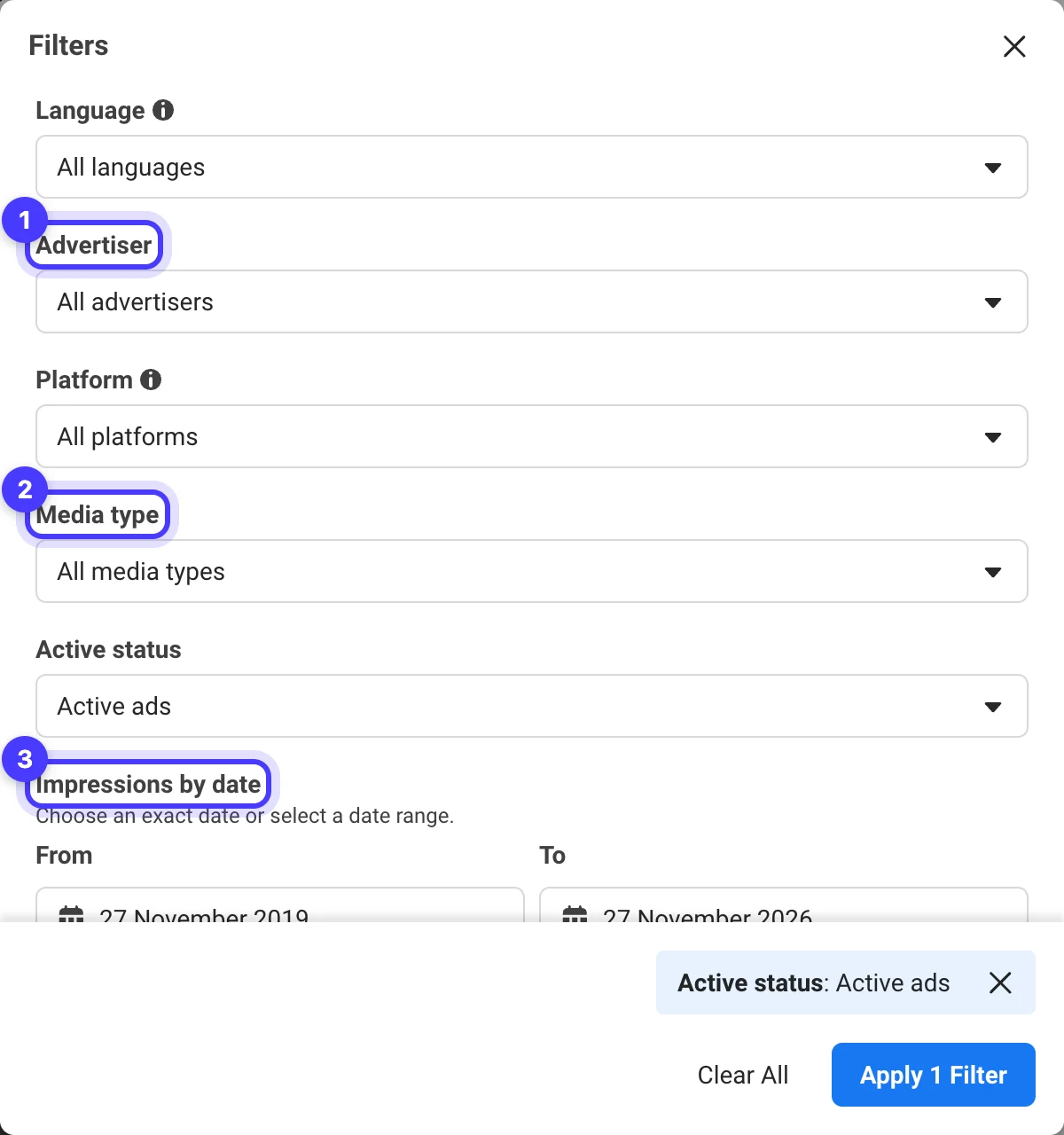
Know what the free library holds before you rely on it. Meta's Ad Library contains every active ad, plus branded content, ads about social issues, elections or politics, and ads delivered to the United Kingdom and the EU. A commercial ad shown only in Australia leaves the library when it stops running, so save anything you want to keep the day you find it. Our guide to the Meta Ad Library in Australia covers the settings in detail.
Step 3: search by the buyer's problem, not the brand
Browsing competitors runs dry quickly. When it does, we switch to keyword searches for the audience's problem in their own words. In the Ad Library, put the phrase in quotes so it runs as an exact phrase search. A search for "sore back" in Australia today returned about 550 active ads: bed frames, cordless garden tools and pain relief rubs, each showing the same problem from a different angle. Three categories, one pain, and none of them our hypothetical client's competitor.
This is where Adspo saves us hours. Its keyword search runs across ad copy, video transcripts and on-screen text, so it finds the ad where the problem is only spoken, which the Ad Library's text search misses. Our rules when we search this way:
- Use an industry filter first to cut unrelated meanings of the phrase, then run an unfiltered pass before deciding nothing exists.
- Scroll past the first screen and try another sort (newest, longest running, ad count). The first screen is the same for everyone who searches.
- Try the buyer's words, not yours. Customers say "my back kills after work", brands say "ergonomic support". Reviews, comments and support emails are the best source of search phrases.
Step 4: read each ad for the pattern it uses
An ad earns a place in the research only if it shows the matching moment: the overlay text, the voiceover line or the demonstration where the problem gets solved. Who ran it, or how good it looks, does not count. For each keeper we note six things:
| Field | What we write |
|---|---|
| Moment | Where the problem appears, in a few words ("wakes up stiff, rolls out of bed slowly") |
| Layer | Hook, voiceover, text overlay or demonstration |
| Format | Talking head, demo, static, UGC, before and after, carousel |
| Offer and proof | Price or promise shown, plus the proof used (review, number, expert, visible result) |
| Signals | Runtime, number of versions, and in Adspo the creative's impression rank in its brand's account |
| Pattern | The reusable idea in one line, written so it does not mention the brand |
Read the signals carefully. Longevity, ad count and apparent scale tell you an advertiser kept paying for an ad, not that it made money. A long runtime with a low impression rank is often an ad nobody switched off. We cover the signals properly in how to find winning Facebook ads, and the opening seconds in our hook research guide.
Step 5: build a persona board of 20 distinct ads
The output of research is a board, one per persona. Ours hold 20 distinct ads, with no more than two from the client's own brand, and they follow four rules:
- Every ad shows the matching moment. Mood boards of nice-looking ads brief nothing.
- No near-duplicates. The same footage with a shorter script or a lightly changed hook is one concept, and takes one slot.
- Outside the category is welcome when another category shows the same problem being solved better.
- English boards use English messaging or a language-neutral demonstration. Check the creative itself, because a transcript can be attached to the wrong video.
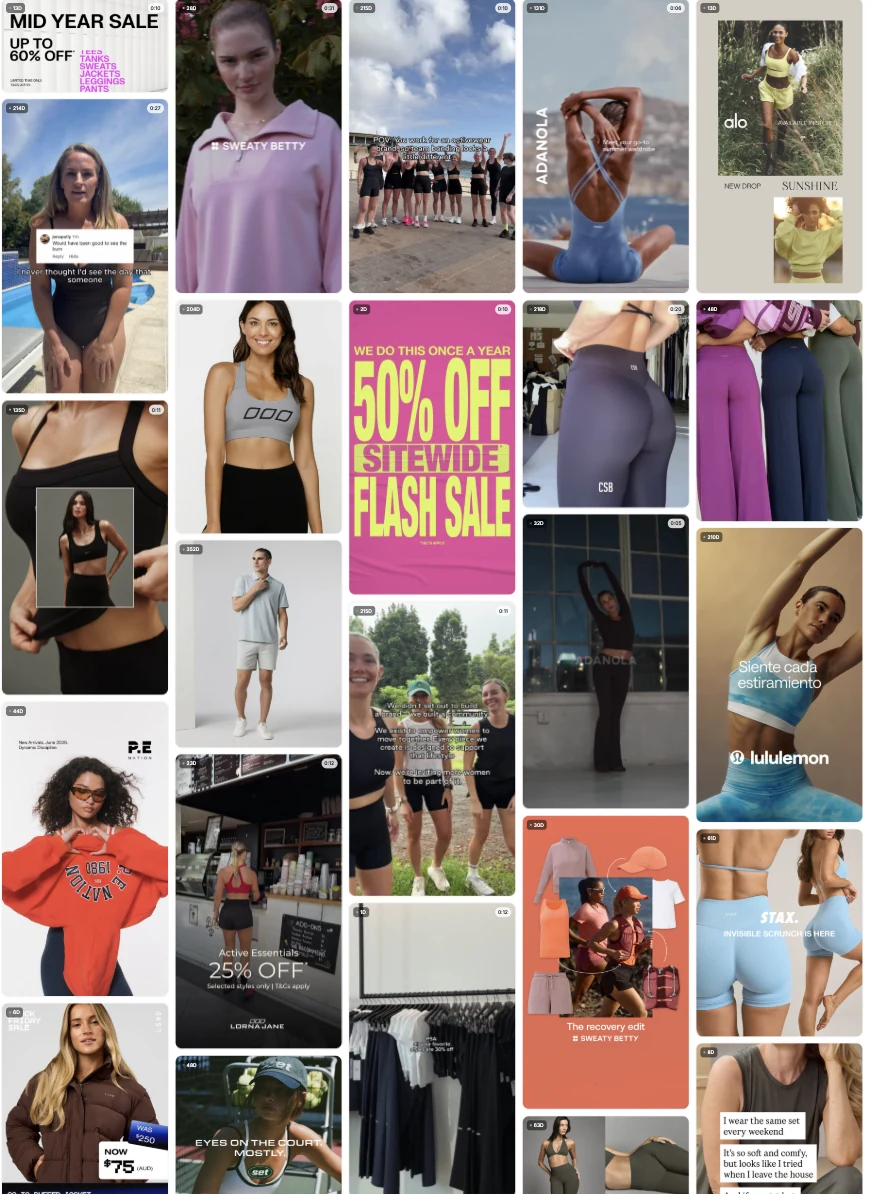
We keep these boards in a Personas folder inside each brand's Adspo space and embed the shared board next to the persona it briefs, so the writer, the editor and the client look at the same 20 ads. A spreadsheet with links does the same job for free; it just takes longer to scan. Our ad swipe file guide covers the structure and the note we write on every save.
Step 6: turn the board into a brief and a test
Group the 20 ads by pattern. Three to five patterns usually emerge, and each becomes a concept with a one-sentence hypothesis: "If we show [moment] through [format], [persona] will stop and watch, because [reason from the research]."
For each concept the brief carries:
- the hypothesis and the persona it serves;
- three opening lines written fresh from the pattern, never lifted from a reference;
- the two or three board ads that show the pattern best, linked;
- format, length and safe zones;
- the proof and offer, from your own business;
- what result would make you make more of it, and what would make you stop.
Take the pattern, never the ad. Another brand's script, claim, footage or distinctive phrase is theirs. Then size the test: how many concepts your budget and production can carry each month. Our free creative testing pipeline planner does that arithmetic.
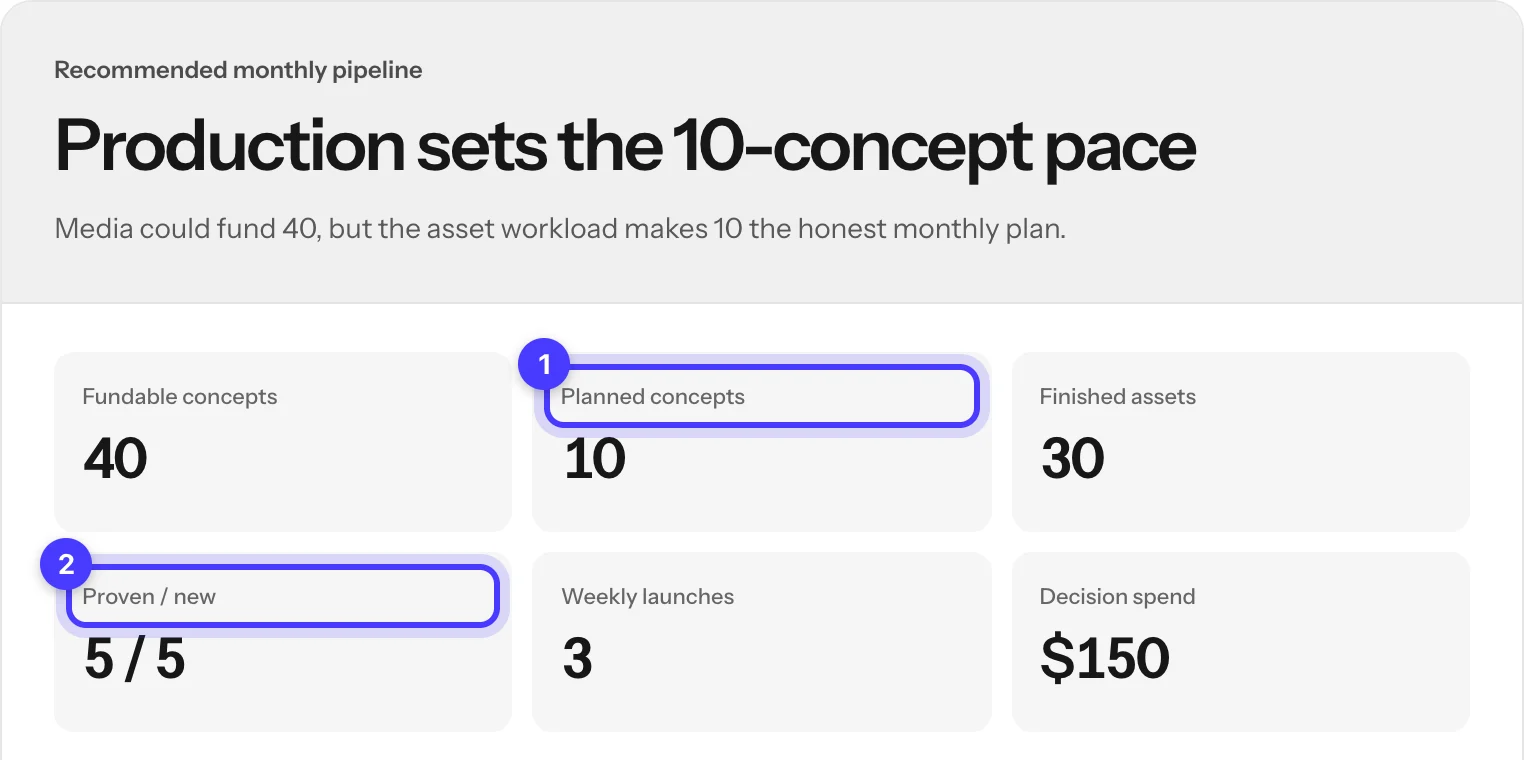
The research, the brief and the test are one loop. Our weekly paid creative system shows how we run it every week, and how many ad creatives to test covers the volume question.
What makes an ad worth testing?
Explore 46 real ads and 17 landing pages. We break down the offer, the proof and what we’d try next.
A worked example
An invented Australian brand selling a supportive mattress topper wants three new video concepts before winter.
- Question: for side sleepers who wake with a sore shoulder, what are other advertisers showing that makes a better night feel solved?
- Map: four topper and mattress brands, plus pillows, sleep supplements and weighted blankets, plus anything about stiff mornings.
- Search: "sore shoulder", "wake up stiff" and "side sleeper" as exact phrases in the Ad Library, then the same phrases across transcripts in Adspo.
- Read: 60 candidates noted, 20 kept. Three patterns repeat: a morning-routine contrast (stiff today, easy tomorrow), a hand pressing into the product to show depth, and a partner's point of view.
- Brief: one concept per pattern, three openings each, nine finished videos.
- Test: launch the three concepts in the same week and judge them on cost per purchase after the agreed spend.
The whole round fits in an afternoon, and the brief is ready for a creator the next morning.
Free library or a paid tool?
For one brand and one launch, the Meta Ad Library and a spreadsheet are enough. A paid tool earns its cost when you research every week, across several brands, or need ads that have ended.
| Job | Meta Ad Library | Adspo |
|---|---|---|
| See a brand's active ads | Yes, free | Yes, one card per creative |
| Search spoken words | No transcripts | Copy, transcripts and on-screen text |
| Australian ads after they stop | Gone | Kept, with launch and end dates |
| Save and share boards | No | Boards, spaces, shareable links |
| Cost | Free | US$29 a month, or US$19 a month billed yearly |
Adspo has real limits. It covers Meta only, it shows no spend or sales data, and local trade and service categories are thin: for those we work the Ad Library directly. The yearly plan starts with a 14-day trial if you want to run your next research round in Adspo. We also run much of this discovery inside Claude, which our Meta Ad Library and Claude guide walks through.
If you would rather hand the whole loop to a team that runs it every week, from research to brief to tested ads, tell us about your account.
Questions we get about Facebook ad research
How do I research competitors' Facebook ads for free?
Open the Meta Ad Library, set the country to Australia and the category to All ads, and search each competitor by name. Then search your buyer's problem as an exact phrase in quotes, use the Filters panel to split by format and date, and save what you find the same day, because Australian commercial ads leave the library when they stop running.
How long should ad research take?
Two to three hours per persona for a first board of 20 ads and a brief. Topping up an existing board before a new round of testing takes under an hour.
How many reference ads do I need for a brief?
We keep 20 distinct ads per persona and link the two or three that show each pattern best in the brief. More references than that slow the writer down without adding ideas.
Can I see how much a competitor spends on Facebook ads?
Not for commercial ads in Australia. Meta shows spend ranges only for ads about social issues, elections or politics. Runtime and the number of versions show what an advertiser kept paying for, not what it spent or earned.
What is the best Facebook ad research tool?
For occasional research, the free Meta Ad Library. For weekly research across several brands, we use Adspo for its transcript search, saved boards and ads kept after they end. It covers Meta only.
Is it legal to copy a competitor's ad?
Take the pattern, not the ad. A structure such as a morning-routine contrast is open to anyone. Another brand's script, footage, claims or distinctive phrases belong to them, and reusing them invites rejected ads and takedown requests.
Sources
- Meta Business Help Centre: About the Meta Ad Library
- Meta Ad Library: keyword search, Filters panel (Advertiser, Media type, Impressions by date), checked 27 November 2026
- Adspo: product and pricing summary (adspo.co/llms.txt)
- Adspo pricing
Disclosure: Hey Sage uses Adspo for client work and earns a referral fee when you subscribe through our Adspo links.