
On this page
- 01 · Where to find Facebook ad hook examples worth copying the shape of
- 02 · What counts as the hook
- 03 · Hook types we see again and again
- 04 · Step 1: search hook phrases in the Meta Ad Library
- 05 · Step 2: search transcripts and opening lines in Adspo
- 06 · Step 3: file hooks by problem, not by brand
- 07 · Step 4: write your own hooks from the patterns
- 08 · How to tell if your own hook works: hook rate and hold rate
- 09 · Questions we get about ad hooks
- 10 · Sources
Where to find Facebook ad hook examples worth copying the shape of
The best hook examples are live ads in your own category and the categories next to it, read for their first three seconds: the opening line, the first frame and any text on screen. Lists of famous hooks are a starting point. The ads your buyers are scrolling past this week are better, because you can see how long each has run and how many versions the advertiser keeps paying for.
Two routes get you there. The free one is the Meta Ad Library: search the words a hook uses in quotes, filter to videos and sort by impressions. The faster one is an ad research tool that stores each video's opening line and transcript so you can search across them. We use Adspo for this on client work. Either way, you are collecting patterns to brief, never lines to copy.
What counts as the hook
A hook is everything a viewer takes in before they decide to keep watching or scroll on. In a Meta video ad that is roughly the first three seconds, which is also the threshold Meta uses for its 3-second video plays metric. It has three layers, and strong ads make all three say the same thing:
| Layer | What it is | Where to read it |
|---|---|---|
| Spoken line | The first sentence of the voiceover or presenter | Play the ad with sound, or read the start of the transcript |
| On-screen text | The overlay in the first frame, often the only hook people see with sound off | Pause on the first frame |
| Opening visual | What moves first: a face, a hand, the product, the problem happening | Pause on the first frame, then watch to second three |
For an image ad the hook is the image itself plus the opening words of the primary text above it. Record which layer did the work when you save an example. A brilliant spoken line on a dull first frame is a different lesson from a dull line on a frame that stops the thumb.

Run Better Ads: our free ecommerce guide
We’ve tracked $700m+ in ad revenue across 200+ brands. See how we work out what a sale can cost and choose which ad to test next.
Hook types we see again and again
These are the openings that keep turning up in long-running Meta ads when we research a brief. The example lines are ours, written for an imaginary pillow brand, so you can see the shape without borrowing anyone's words.
| Type | Shape | Example line |
|---|---|---|
| Audience callout | Names who the ad is for in the first breath | "If you wake up with a stiff neck most mornings, watch this." |
| Problem shown | The problem happens on screen before anyone speaks | A sleeper folding a flat pillow in half, then giving up |
| Hindsight | A buyer wishes they had found it sooner | "I wish I knew about this pillow two years ago." |
| Contrarian | Argues against the obvious choice, then reveals the better one | "Three reasons I'd never buy a memory foam pillow again." |
| Question | Asks the viewer something they will answer yes to | "Do you flip your pillow to the cold side every night?" |
| Result first | Opens on the after, then explains the before | "Eight hours, no neck pain. Here's what changed." |
| Demonstration | A test the viewer wants to see finish | A bowling ball dropped onto the pillow |
| Offer | Leads with price, bundle or deadline | "Two pillows for the price of one ends Sunday." |
Most strong ads combine two: an audience callout spoken over the problem shown, or a hindsight line over a demonstration. When you save an example, tag it with every type it uses. Our guide to finding winning Facebook ads covers how to read longevity and version counts, which is how you decide which examples deserve a place.
Step 1: search hook phrases in the Meta Ad Library
Open the Meta Ad Library, set the country to Australia and the category to All ads. Type a hook phrase in quotes, for example "I wish I knew" or "if you're a", so the search matches it exactly. Open Filters, set Media type to Videos, then check Sort by is on Impressions: high to low, which puts the most-served ads at the top. The other option is Most recent, useful for spotting a hook that has just started spreading.
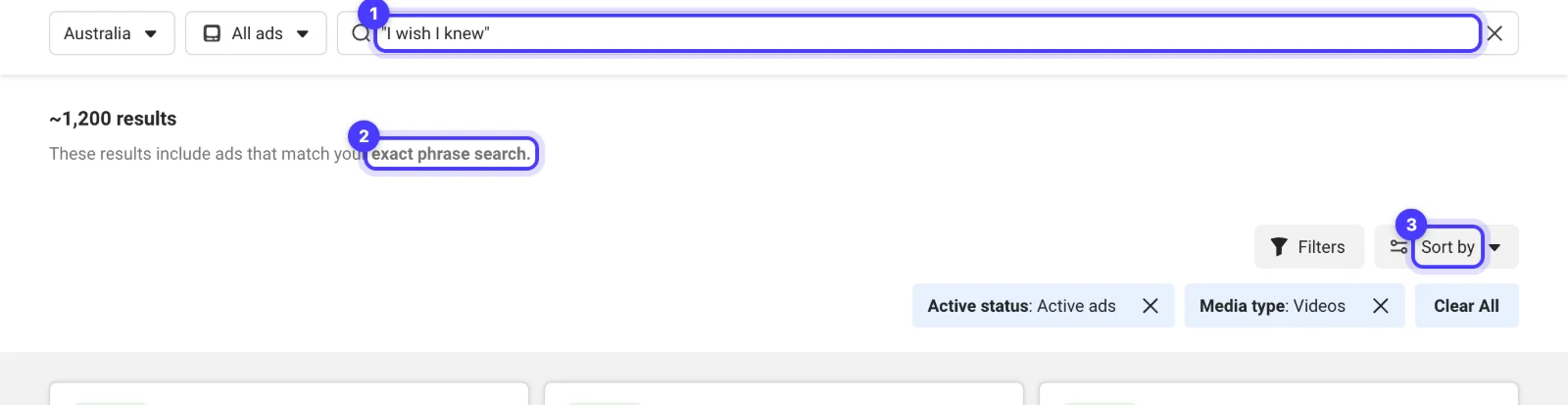
On 25 November 2026 that search returned about 1,200 active video ads in Australia. Three habits make the results useful:
- Search the problem, not just the formula. Your buyer's problem in their words ("stiff neck", "won't stay on", "too hot at night") finds openings that speak to the same person, often from other categories.
- Play every video from the start. The library shows the ad's text, but the spoken line and the first frame only show when you play it.
- Note the start date and versions. Each card shows when the ad started running, and "This ad has multiple versions" means the advertiser runs more than one version of it.
The limits are real. Australian ads disappear from the library when they stop, there is no transcript to search, and every hook has to be found by playing ads one at a time. Our guide to the Meta Ad Library in Australia covers the settings and what each card shows.
Step 2: search transcripts and opening lines in Adspo
This is where Adspo earns its place in our research. Every video creative carries its transcript, its ad copy and a hook field holding the opening line, and a keyword search can run across copy, transcripts, on-screen text and landing page URLs at once or one at a time. Searching the transcripts for "back pain" today returned long-running video ads from mattress toppers, magnesium sprays, chiropractors and pregnancy pillows, each listed with its opening line. That is a page of hooks for one problem across four categories, read in a minute instead of an afternoon.
How we work it on a brief:
- Search by the audience's problem across copy, transcript and on-screen text. An industry filter cuts unrelated meanings, then we run an unfiltered pass before deciding nothing exists, scroll past the first screen and try another sort.
- Filter by visual format when the brief calls for one: Talking Head, Customer Testimonial, Podcast, POV, Demo or Before & After are among the tags, so you can pull fifty talking head openings without wading through product shots.
- Sort by longest running and read each creative's impression rank inside its brand's account, where 1 is the brand's most-served creative.
- Check the creative itself. A transcript can be mismatched to the video, and the opening-line field sometimes holds a whole paragraph rather than the first sentence. Play it before you file it.
We do most of this discovery inside Claude through the Adspo connector, which runs the same searches, returns full copy and transcripts and reads back board contents before we brief. Our guide to the Meta Ad Library in Claude shows the setup.
Adspo costs US$29 a month with a 7-day free trial, or US$19 a month billed yearly with a 14-day trial (checked 25 November 2026). It covers Meta ads only, its library is weighted to ecommerce brands, and local trade and service categories are thin or missing, so for those we go back to the Meta Ad Library. It shows no spend or sales figures for any brand. Our Adspo review covers the rest.
Step 3: file hooks by problem, not by brand
A folder of saved ads grouped by advertiser tells you what competitors do. A hook inventory grouped by the problem it opens on tells you what to make next. For each hook we keep:
| Field | Example entry |
|---|---|
| Opening line, in our own summary | Hindsight: buyer wishes they found it years ago |
| Layer that does the work | Spoken line, with the product already in hand |
| Problem or persona | Side sleeper with neck pain |
| Format | Talking head, 9:16 |
| Category it came from | Pregnancy pillows (outside our category on purpose) |
| Signals | Running 392 days across 4 ads, impression rank 474 in its account |
| Link | Library ID or Adspo share link |
Runtime and rank pull in different directions in that example: the brand keeps the ad live but serves dozens of others far more. Read both, and treat them as signals of what an advertiser keeps paying for, never as proof an ad is profitable.
In Adspo these live on boards. For each persona we brief, we build a board of 20 distinct ads with no more than two from the client's own brand, and every ad has to show the matching moment: the overlay text, the voiceover line or the demonstration. A mood or a familiar advertiser does not earn a place. The same footage with a lightly changed hook counts as one concept, so we keep the clearest version and note the other openings beside it.
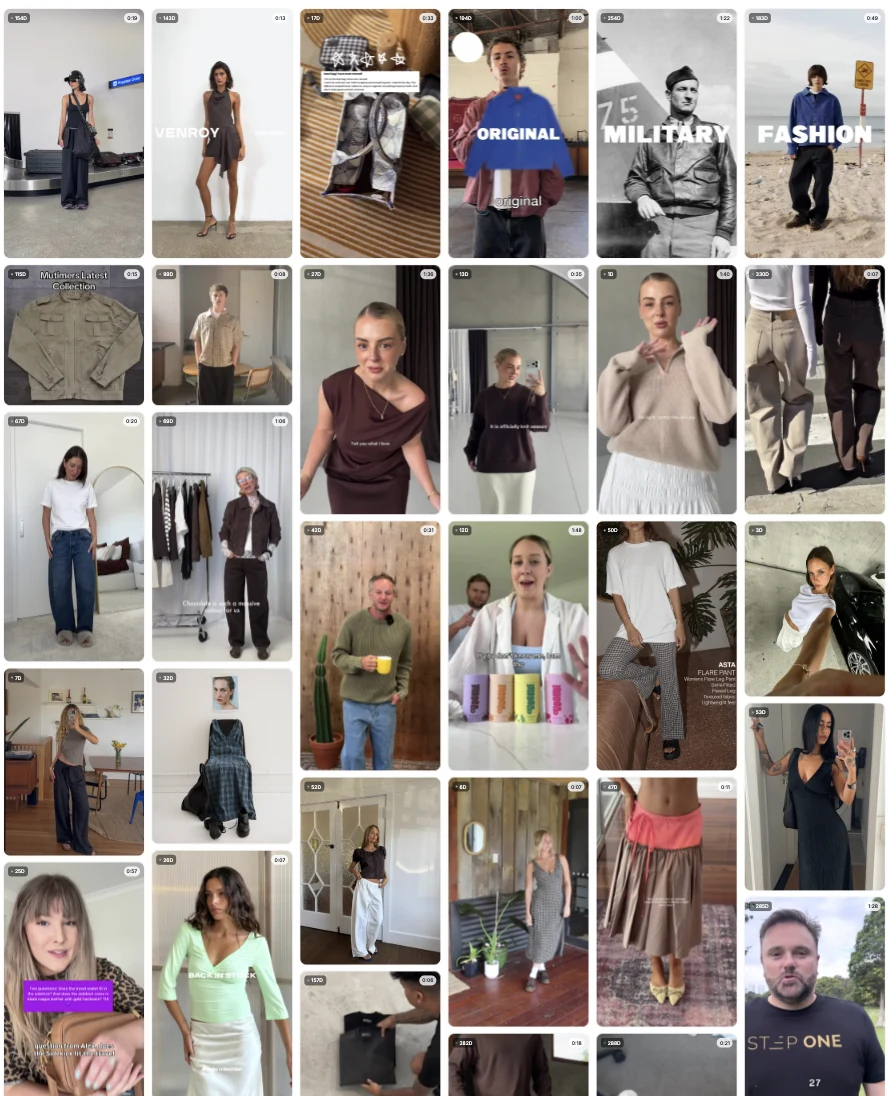
Our ad swipe file guide covers how we organise boards across brands and share them with the people writing the brief.
What makes an ad worth testing?
Explore 46 real ads and 17 landing pages. We break down the offer, the proof and what we’d try next.
Step 4: write your own hooks from the patterns
Take the pattern, never the line. For every concept we brief, we write three openings in the brand's own words, each borrowing a different shape from the inventory: say a hindsight line, a problem shown and a question. Each one names the spoken line, the first-frame visual and the on-screen text, so the editor knows exactly what to shoot for the first three seconds.
Two checks before anything is filmed. First, the on-screen hook has to sit clear of the platform's buttons and captions. In Reels and Stories that means the middle of the frame, away from the top 14% and bottom 35% Meta asks you to keep clear.
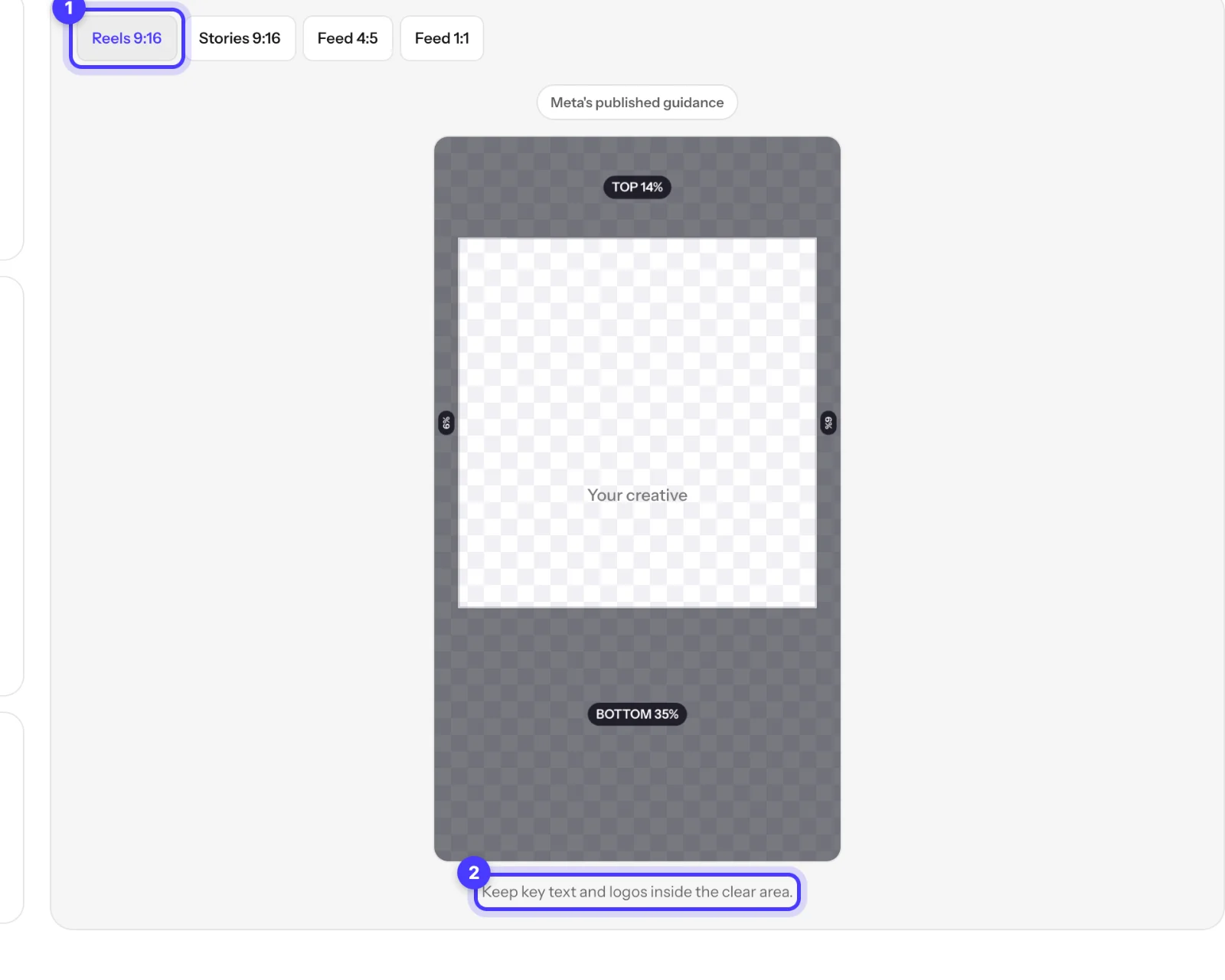
Second, the hooks have to be different enough to teach you something. Three rewordings of one idea is one test. Our guide to how many ad creatives to test sets how many concepts and openings to brief at once, and the Meta ads preview tool shows the first frame in Feed, Stories and Reels before you launch.
How to tell if your own hook works: hook rate and hold rate
Meta does not report a hook metric, so build one. Hook rate is 3-second video plays divided by impressions. Meta counts a 3-second video play when the video plays for at least three seconds, or for 97% of its length if it is shorter, and replays in the same impression do not count. Hold rate is ThruPlays divided by 3-second video plays, where Meta counts a ThruPlay when the video plays to completion or for at least 15 seconds (Meta's help centre now calls the metric 15-second ThruPlays).
To add hook rate to Ads Manager:
- Open Columns and choose Customise columns.
- Select Create custom metric.
- Build the formula 3-second video plays divided by Impressions.
- Name it Hook rate, set the format to percentage and choose who can see it.
- Click Create metric, then repeat with 15-second ThruPlays divided by 3-second video plays for hold rate.
Compare hook rates between ads in your own account rather than against published averages: placement mix, audience and format move the number more than any benchmark accounts for. A high hook rate with weak results usually means the opening earned attention the rest of the ad did not pay off. Our weekly paid creative system shows where hook rate sits beside the metrics that decide spend.
If you would rather hand over the research, the hooks and the testing, that is the creative work we run for brands every week.
Questions we get about ad hooks
What is a hook in a Facebook ad?
The first two or three seconds of the ad: the opening spoken line, the first frame and any text on screen. For an image ad it is the image plus the first line of primary text. Its only job is to make the right person keep watching.
How long should a Facebook ad hook be?
Aim to land the idea inside three seconds, which is when Meta counts a 3-second video play. One short spoken sentence and an on-screen line of five to eight words fits that window.
What is a good hook rate on Meta?
Hook rate is 3-second video plays divided by impressions. Judge it against your own account's other ads in the same placements and format, since vendor averages mix very different accounts. Raise it by testing different openings on the same body.
Can I search the Meta Ad Library for hooks?
Yes, by putting the hook's words in quotes as an exact phrase search, filtering to videos and sorting by impressions. You still have to play each video to hear the spoken line, because the library has no transcript search.
Is it OK to copy a competitor's hook?
Copy the shape, not the words. A hindsight line or an audience callout is a pattern anyone can use. Another brand's script, claim, footage or distinctive phrase is theirs, and reusing it invites rejected ads and takedown requests.
Does Adspo work for TikTok hooks?
No. Adspo covers Meta ads only. Many brands run the same videos on both, so Meta openings still teach a lot, but for TikTok-only research use TikTok's own Creative Center.
Sources
- Meta Business Help Centre: 3-second video plays
- Meta Business Help Centre: 15-second ThruPlays
- Meta Business Help Centre: Create custom metrics in Meta Ads Manager
- Meta Ad Library
- Adspo: product and pricing summary (adspo.co/llms.txt)
- Adspo pricing
Disclosure: Hey Sage uses Adspo for client work and earns a referral fee when you subscribe through our Adspo links.