
On this page
- 01 · Can you run giveaway ads on Meta in Australia?
- 02 · Meta's promotion rules for Facebook and Instagram
- 03 · Do you need a trade promotion permit? State by state
- 04 · Setting up the giveaway campaign
- 05 · Entering is not permission to email
- 06 · Will the giveaway pay? Work it out per buyer
- 07 · The follow-up is what pays for the giveaway
- 08 · Giveaway checklist before you launch
- 09 · Questions we get about giveaway ads
- 10 · Sources
Can you run giveaway ads on Meta in Australia?
Yes. Meta lets you run and advertise a giveaway from your Facebook Page or Instagram account, as long as you publish official rules, include a release of Meta, and never ask people to share to their timeline or tag friends to enter. In Australia a random prize draw is a trade promotion lottery, and the states decide whether you need a permit: if your total prize pool is $3,000 or less and entry is free, no state requires one. Run the ad as a Leads campaign with an instant form or a landing page, ask for email consent in the form, and measure the giveaway by what each eventual buyer cost you.
Most giveaways we see fail on the last step. Entries arrive at 50 cents each, the list grows, and three months later nobody can say whether any of those people bought. The rest of this guide covers the rules first, then the setup, then the arithmetic and the follow-up that make a giveaway worth running.
Meta's promotion rules for Facebook and Instagram
Meta's Pages, Groups and Events Policies and Instagram's Promotion Guidelines say the same things. You are responsible for running the promotion lawfully, including:
- Official rules: the terms of the offer and who can enter (age and residency).
- Legal compliance: the laws for the promotion and the prizes, including any registration or regulatory approval, which in Australia means the state permits below.
- A release of Meta: every entrant releases Facebook (or Instagram) completely, and the rules state that Meta does not sponsor, endorse, administer or associate with the promotion.
On Facebook, promotions run on your Page or in an app. Personal timelines and friend connections are off limits, so these mechanics break the rules: share on your timeline to enter, share on a friend's timeline for extra entries, and tag your friends in this post to enter. On Instagram, you must not tag content inaccurately or ask entrants to, for example by asking people to tag themselves in a photo they are not in. Meta does not help run promotions, and Instagram will not advise on whether you need permission to reuse entrants' content, so put that permission in your terms if you plan to repost entries.
When a giveaway counts as gambling
Meta's online gambling and games policy treats a promotion as gambling when something of monetary value is part of both the way you enter and the prize. A free-entry giveaway falls outside that definition. Paid-entry sweepstakes need Meta's written permission before you can advertise them. Prize promotions where entry comes from buying a product at its usual retail price are allowed without permission, provided gambling is not your main business.

Run Better Ads: our free ecommerce guide
We’ve tracked $700m+ in ad revenue across 200+ brands. See how we work out what a sale can cost and choose which ad to test next.
Do you need a trade promotion permit? State by state
A giveaway decided by a random draw is a trade promotion lottery, a game of chance. Each state and territory sets its own rules, and a national giveaway has to satisfy every state whose residents can enter. The thresholds below are total prize value, checked against each regulator's page today.
| State or territory | Permit needed? | Other conditions worth knowing |
|---|---|---|
| New South Wales | An authority when the total prize value exceeds $10,000. Fees for 2026 to 27: $527 for one year ($488 online), $790 for three years, $1,053 for five. | The authority number goes on every ad. Firearms, tobacco, vapes and cosmetic surgery cannot be prizes, and liquor prizes are capped. |
| Victoria | No permit. | Written consent from the business being promoted, winners of prizes over $1,000 published online for at least 28 days, records kept for three years, prizes paid within 28 days. The conditions of entry must say if you will use entrants' details for anything other than the draw. |
| Queensland | No licence for a free-entry promotional draw (a category 4 game). | Regulated under the Charitable and Non-Profit Gaming Act 1999. |
| South Australia | A licence when prizes decided by draw total $5,001 or more. | Winners get at least 14 days to claim; a scrutineer is needed above $30,000; records kept for at least three months after the draw. |
| Western Australia | No permit, if you meet the conditions. | Free entry, a maximum of 12 months, the draw within one month of closing, terms fixed once it starts, records kept for 12 months. |
| Australian Capital Territory | Approval when total prizes are more than $3,000; at $3,000 or less it is an exempt lottery with conditions. | Covers chance and a mixture of chance and skill. Approval comes before you advertise. |
| Northern Territory | A permit for prizes over $5,000. | Approval takes up to 10 days; a permit from another state is accepted. |
| Tasmania | Trade promotions are permitted gaming. | The state's page describes promotions entered by buying goods at the market price with no extra charge. For a free-entry draw open to Tasmanians, confirm with Liquor and Gaming before you launch. |
So a $500 prize pack needs no permit anywhere, a $4,000 prize needs ACT approval if Canberra residents can enter, and a $12,000 prize adds South Australia, the Northern Territory and New South Wales. If you want to stay inside one state's rules, limit eligibility to that state in the official rules and target the ad to it.
Games of skill
A competition judged purely on skill, such as the best answer in 25 words, is not a lottery under South Australia's definition. A simple question followed by a random draw still is. Victoria's rules apply even when the event includes a skill element, and the ACT covers a mix of chance and skill, so a skill round does not take a draw outside the lottery rules.
Setting up the giveaway campaign
We run giveaways as a Leads campaign. An instant form keeps the entrant on Facebook or Instagram and usually costs less per entry; a landing page lets you show the full rules and add people straight to your email platform. Our guide to Facebook lead ads vs a landing page compares the two on cost per qualified lead.
- Write the official rules first: promoter, eligibility, start and close times with the time zone, the draw date and method, the prize and its value, how winners are told, the unclaimed prize redraw, the release of Meta and what you will do with entrants' details. Link them from the ad and the form.
- Set the audience: Meta's lead ad terms say lead ads must not be targeted to minors, and your rules will set an entry age anyway, so set the age minimum to match.
- Build the form: ask for email and first name, and add a question only if the answer changes what you send next (for example which product range interests them). Add your privacy policy link. Meta's help pages disagree on whether it is required, so we always include it.
- Add the consent tick box: in the form's custom disclaimer, add a consent check box that says what you will send. Meta lets you make each check box required or optional. You cannot add a disclaimer to a form already running in an ad, so build it before launch or duplicate the form.
- Test the path: send a test lead with our Meta Lead Ads Testing Tool guide and check it lands in your email platform with the consent recorded.
Keep entrants in their own list or segment. Our BFCM budget and launch plan makes the same point for sale season: giveaway entrants and people who asked for early sale access are different audiences and buy at different rates.
Entering is not permission to email
Under the Spam Act, you need consent before you send marketing emails or texts, and the business has to prove it. The ACMA lists accepting the terms and conditions when entering a competition as one way of giving express consent, but only when those terms are available at the point of entry and say what the consent is for, who will use it, how long it lasts and how to withdraw it. Someone who entered a draw has not given inferred consent: the ACMA says inferred consent needs an ongoing relationship.
We write the tick box in one plain sentence ("Send me Brand emails with new products and offers. Unsubscribe any time.") and keep a record of who agreed, when and how, which the lead form gives you. Every email then needs your business name or ABN and an unsubscribe that is free, needs no login and is honoured within five working days.
What makes an ad worth testing?
Explore 46 real ads and 17 landing pages. We break down the offer, the proof and what we’d try next.
Will the giveaway pay? Work it out per buyer
Cost per entry is the number the ad reports and the least useful one. What matters is what each entrant who goes on to buy has cost you. Here is an invented example for a store with a $120 average order and a 40% gross margin, so each first order leaves $48 of gross profit.
- Prize: a $500 pack that costs $300 at cost price.
- Ad spend: $2,400 for 4,000 entries, or 60 cents an entry.
- Total cost: $2,700, or 67.5 cents per entrant.
- Entrants who buy within 60 days: 45, which is 1.1%.
- Cost per buyer: $2,700 divided by 45, or $60.
At $60 a buyer, the first order ($48 of gross profit) does not cover the cost. The giveaway breaks even on first orders at 57 buyers ($2,700 divided by $48), or 1.4% of entrants. Anything below that has to be paid back by returning orders, which is where our customer retention calculator comes in.
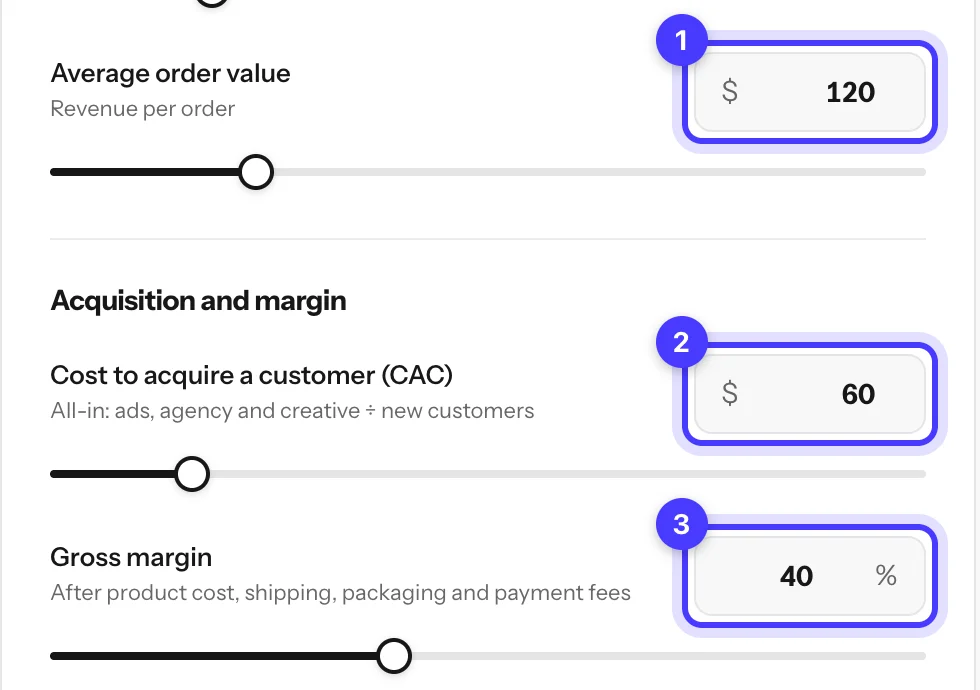
Enter the order value, the giveaway's cost per buyer as the cost to acquire a customer, and your margin. With the calculator's example retention settings (a quarter of customers coming back, 75 days to the second order), a $60 buyer pays back in month 5.
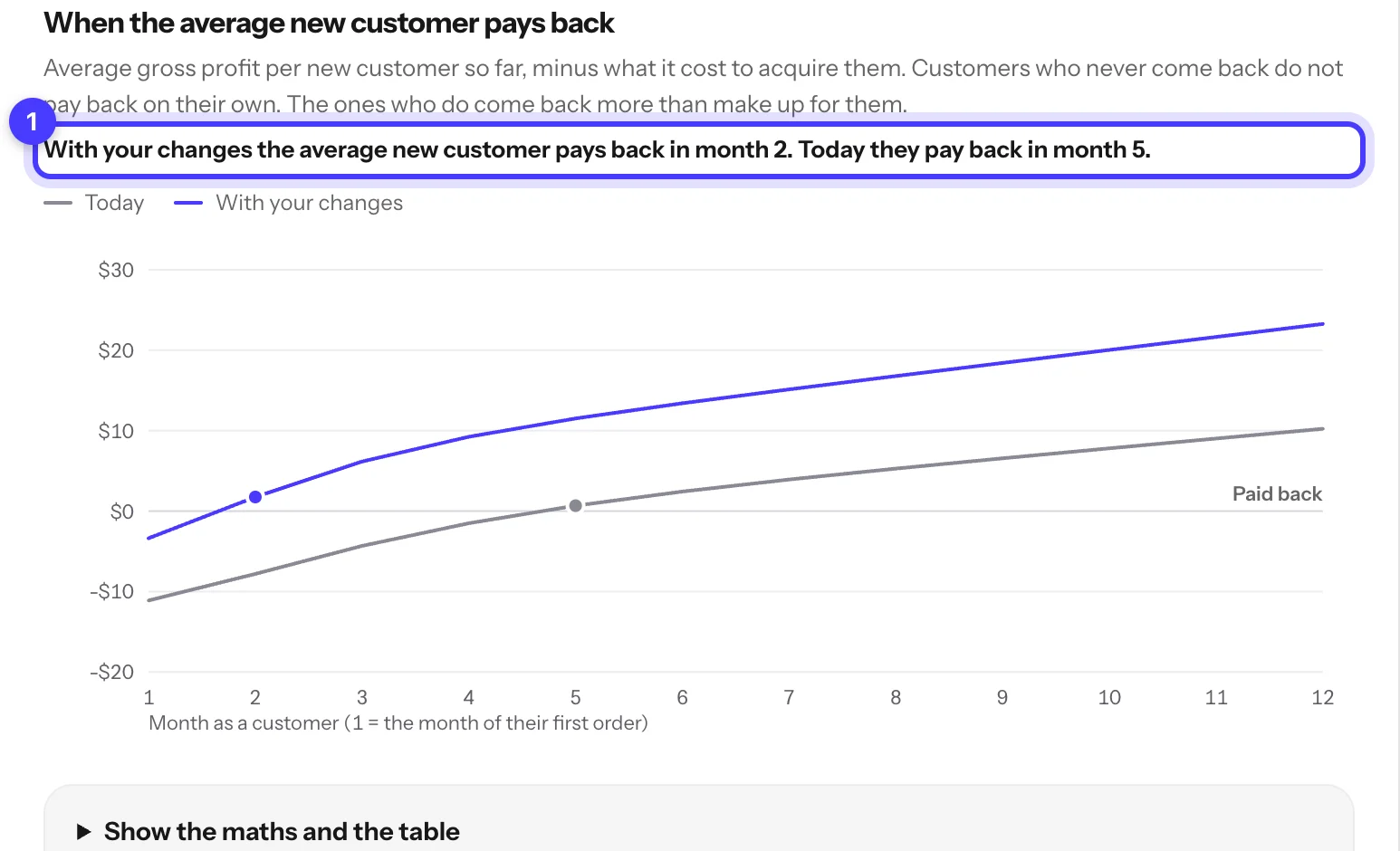
Compare that with your normal prospecting. If your Meta ads already win customers at $40, a $60 giveaway customer is a worse deal, however cheap the entries looked. If they cost $80, the giveaway is the better channel. Use our break-even ROAS guide to set that benchmark with GST taken out of the revenue.
The follow-up is what pays for the giveaway
Most of a giveaway's value arrives after the draw, from the entrants who did not win. We plan the sequence before the ads go live:
- Entry confirmation, sent straight away: thanks, the draw date and one product the entrant is likely to want.
- Two or three emails before the draw that show the range, the reviews and the reasons people buy, without a discount.
- The winner announcement to everyone, followed by a consolation offer with a short deadline. This is the email most likely to turn entrants into buyers.
- A move into your normal emails after two weeks, with entrants who never open removed after 60 to 90 days so they stop dragging down deliverability.
Measure the cohort: buyers from the entrant list within 60 and 90 days, their revenue and their gross profit, against the full cost of the prize and the ads. Our guide to following up Meta lead form leads covers getting form entries into your email platform quickly. If you would rather hand the giveaway, the ads and the follow-up to us, that is part of our Meta ads management.
Giveaway checklist before you launch
- Official rules written, with eligibility, dates and time zone, draw method, prize value and the release of Meta.
- Total prize value checked against each state you accept entries from (ACT above $3,000, NT above $5,000, SA from $5,001, NSW above $10,000).
- No share, tag or timeline mechanics.
- Free entry, or entry by purchase at the usual price; no paid entry.
- Lead form with a privacy policy link and a plain-English consent tick box; test lead received.
- Entrants in their own segment, with the follow-up emails built.
- Break-even buyers worked out before launch, and the cohort review booked for 60 and 90 days after the draw.
Questions we get about giveaway ads
Can I ask people to tag a friend to enter a giveaway on Facebook?
No. Meta's Pages, Groups and Events Policies say promotions must not use personal timelines or friend connections, and give tag your friends in this post to enter as an example of what is not allowed. Asking people to comment on your Page's own post keeps the promotion on your Page, where Meta allows it.
Do I need a permit for an Instagram giveaway in Australia?
It depends on the total prize value and where entrants live. With free entry and total prizes of $3,000 or less, no state needs a permit. The ACT requires approval above $3,000, the Northern Territory above $5,000, South Australia from $5,001 and New South Wales above $10,000.
Can I boost a giveaway post?
Yes. A boosted giveaway post is an ad, so the same promotion rules and state thresholds apply. For list building we prefer a Leads campaign with an instant form, because a boosted post collects comments rather than email addresses with consent.
Can I add giveaway entrants to my email list?
Only with their consent. Add a consent tick box to the entry form that says what you will send, and keep the record. The ACMA accepts competition terms as express consent only when they explain what the consent is for and how to withdraw it.
Is a sweepstakes ad gambling on Meta?
Meta treats a promotion as gambling when something of monetary value is part of both the entry and the prize. Free entry is outside that definition and so is entry by buying a product at its usual price. Paid-entry sweepstakes need Meta's written permission to advertise.
Sources
- Facebook Pages, Groups and Events Policies: Promotions
- Instagram Help Centre: Promotion guidelines
- Meta Transparency Centre: Online gambling and games
- Meta Business Help Centre: Add a custom disclaimer to an instant form
- NSW Government: Trade promotions
- VGCCC: Conducting trade promotion lotteries
- SA Government: Trade promotions
- WA Racing, Gaming and Liquor: Trade promotion lottery
- ACT Gambling and Racing Commission: Trade promotions
- ACMA: Avoid sending spam
- ACMA: Dealing with spam