
On this page
- 01 · What an advertorial landing page is
- 02 · Advertorial vs landing page vs product page
- 03 · When an advertorial beats sending ads to the product page
- 04 · The advertorial structure we build, top to bottom
- 05 · The disguise rules: what Meta, Google and Australian law say
- 06 · Worked example: does the advertorial pay for itself?
- 07 · How to test an advertorial against your product page
- 08 · Advertorial mistakes we see most
- 09 · Questions we get about advertorial landing pages
- 10 · Sources
What an advertorial landing page is
An advertorial landing page is a page that sits between your ad and your product page and sells by explaining. Instead of dropping a cold visitor onto a price and an Add to cart button, it walks them through why the product exists, who it is for and why it works, usually as a short numbered article such as "7 reasons desk workers are switching to this chair", then sends them to the product page or checkout ready to buy.
The word comes from print, where an advertorial was an ad written to look like the magazine's own editorial. That is the part to leave behind. Fake mastheads, invented journalists and "as seen in" logos you did not earn break Meta and Google ad policies and Australian consumer law, and in our own testing the disguise loses to plain brand voice anyway. What works is the editorial structure, written openly as your brand, with a priced button in the first screen.
Use one when your product needs explaining before people will pay for it. If shoppers already know what it is and only need the price and the size, send them straight to the product page or collection instead.
Advertorial vs landing page vs product page
All three can be the destination of the same Meta or Google ad. They do different jobs.
| Advertorial (pre-sell page) | Custom landing page | Product page | |
|---|---|---|---|
| Main job | Make the case for the product before the visitor sees the full shop page | Match one ad, audience or offer and get the sale or lead on the page | Let someone who already wants it choose a variant and buy |
| Typical format | Numbered reasons or a short story, one product, proof under each reason | Hero, proof, offer, FAQ, buy box or form | Gallery, price, variants, reviews, shipping |
| Best traffic | Cold prospecting, new or misunderstood products | Cold and warm traffic with a specific angle | Warm traffic, branded search, Shopping, retargeting |
| Where the purchase happens | Hands off to the product page or cart | On the page or one click away | On the page |
| What to measure | Purchases per session and cost per new customer, not its click-through rate | Purchases or leads per session | Purchase conversion rate |
An advertorial is a kind of custom landing page. The difference is emphasis: the advertorial spends its length on persuasion and education, while a standard custom page spends it on the offer and the buy box.

Run Better Ads: our free ecommerce guide
We’ve tracked $700m+ in ad revenue across 200+ brands. See how we work out what a sale can cost and choose which ad to test next.
When an advertorial beats sending ads to the product page
We reach for an advertorial when at least two of these are true:
- The product needs a reason, not just a price. A new format, a new ingredient, a new category, or something that looks like a dozen cheaper options until you explain the difference.
- The brand is new to the visitor. Cold Meta and TikTok traffic has never heard of you, and a product page assumes they already trust you.
- The price needs justifying. Above roughly $80, people want to understand why before they compare.
- There is one clear hero product. An advertorial argues for one thing. A range of twenty items belongs on a collection page.
- You have proof to put under each claim. Reviews, a demonstration video, a comparison, a guarantee, a number from your own customer survey.
Skip it for retargeting, branded search and sale traffic. Those people already know the product and want the price and the size; every extra page between them and checkout costs you orders. The same goes for Google Shopping clicks, which land on the product they clicked.
The advertorial structure we build, top to bottom
This is the skeleton we use for brands whose ads we run. It follows the rules in our cold-traffic landing page guide: confirm the ad in the first screen, keep the brand's own voice, and put the offer where the reader can act.
- Headline that names the person and the product. "6 reasons side sleepers are swapping to this contoured pillow" beats a clever line with no product in it. Lead with the buyer's real reason (comfort, price, how it looks, who else bought it), not the mechanism.
- Your logo and brand name in the header. The reader should know whose page this is in the first second.
- A priced button in the first screen. Some readers are sold by the ad alone. Let them go straight to the product page.
- Five to seven numbered reasons. Each one a benefit heading in the customer's words, two or three sentences, and one image, short video or review that proves that reason.
- The objection block. Shipping time and cost to Australian addresses, returns, sizing or fit, how long it lasts. These are the questions that stop a first purchase.
- Verbatim reviews. Copied exactly from your review platform, named and dated as they appear there.
- The offer. Price, what is included, any guarantee, then a button to the product page with the right variant pre-selected, or a short chooser if there are two or three options.
- A short FAQ for the questions left over.
Before you build, write the chain in one line: ad hook, headline, first proof, button destination. If the headline does not continue the ad's promise, the page loses the visitor in the first two seconds. Check the ad itself in our Meta ads preview tool so the hook you are continuing is the one people actually see in Feed and Reels.
Length follows the job. Most of ours read in two to four minutes on a phone. Long enough to answer the questions that stop the sale; short enough that the button is never far away.
The disguise rules: what Meta, Google and Australian law say
The fake news article style is where advertorials get brands into trouble. These are the rules that apply to an Australian advertiser, checked against each source on 25 November 2026.
| Source | What it says | What it means for your page |
|---|---|---|
| Meta Community Standards: Prohibited commercial practices (ads must comply) | Bans falsely claiming to represent, or speak in the voice of, an established business or entity, and falsely using a public figure's name, likeness or imagery, to bait people | No fake news masthead, no publication logos you were never featured in, no celebrity faces or quotes you have no rights to |
| Meta Advertising Standards: Health and wellness | For weight, health and cosmetic products, bans sensational clickbait claims and statements that attack someone's appearance; cosmetic and weight ads must target people 18 and over | The headline sells the outcome without insulting the reader's body or promising a result by a date |
| Google Ads: Misrepresentation | Bans ads that do not clearly indicate they are ads, implied endorsement by a brand or organisation that does not support you, clickbait, and claims that promise an improbable result as the likely one | The same honesty applies to your Google traffic, and Google judges the ad and the landing page together |
| Google Ads: Destination requirements | Disapproves destinations built mainly to show ads or to send people elsewhere without original content | A thin bridge page with one paragraph and a button will not pass; give the page real substance |
| Marketing Association of Australia (formerly AANA) Code of Ethics, section 2.7 | Advertising must be clearly distinguishable as advertising; the code covers advertorials and native content | The reader must be able to tell it is your brand selling. Brand voice and your logo in the header do that more naturally than a small label |
| ACCC: false or misleading claims, and online reviews | Claims need reasonable grounds whether or not you meant to mislead; writing or arranging fake reviews is against the law; undisclosed paid reviewers mislead | No invented testimonials, comment sections or "reader stories". Any statistic comes from a real test you can show |
The penalties are not small. Since 28 March 2026 the maximum for a company under the Australian Consumer Law is the greatest of $100 million, three times the benefit gained, or 30% of adjusted turnover during the breach period, according to the ACCC.
None of this costs you conversions. The structure, the numbered reasons, the proof and the story all stay. What goes is the costume, and in our tests the costume was the weakest version of the page.
What makes an ad worth testing?
Explore 46 real ads and 17 landing pages. We break down the offer, the proof and what we’d try next.
Worked example: does the advertorial pay for itself?
An invented example in AUD. A brand sells a $129 contoured pillow (GST included) at a 60% gross margin. Meta prospecting sends 6,000 sessions a week at a cost of $6,000, about $1 a session.
Product page as the destination: 1.2% of sessions buy, so 72 orders. Cost per order is $6,000 ÷ 72 = $83.33.
Advertorial as the destination: 30% of readers click through to the product page (1,800 sessions) and 6.5% of those buy, so 117 orders, 1.95% of the original 6,000 sessions. Cost per order is $6,000 ÷ 117 = $51.28.
Is either profitable? Remove GST first: $129 ÷ 1.1 = $117.27. At a 60% margin that leaves $70.36 per order to spend on getting it, the break-even cost per order (our break-even ROAS guide walks through the same sum). The product page loses $12.97 on every order. The advertorial makes $19.08.
Notice what we measured: orders per session that landed on the advertorial. The 30% click-through rate on its own tells you nothing, because a page can push lots of people to the product page who then do not buy. Our study of landing page clicks against purchases found exactly that gap.
Before you trust a result like this, check you ran enough traffic to tell the two pages apart. In our cold-traffic landing page test planner, a 1.2% product page tested for a 40% lift needs about 9,658 sessions per page.
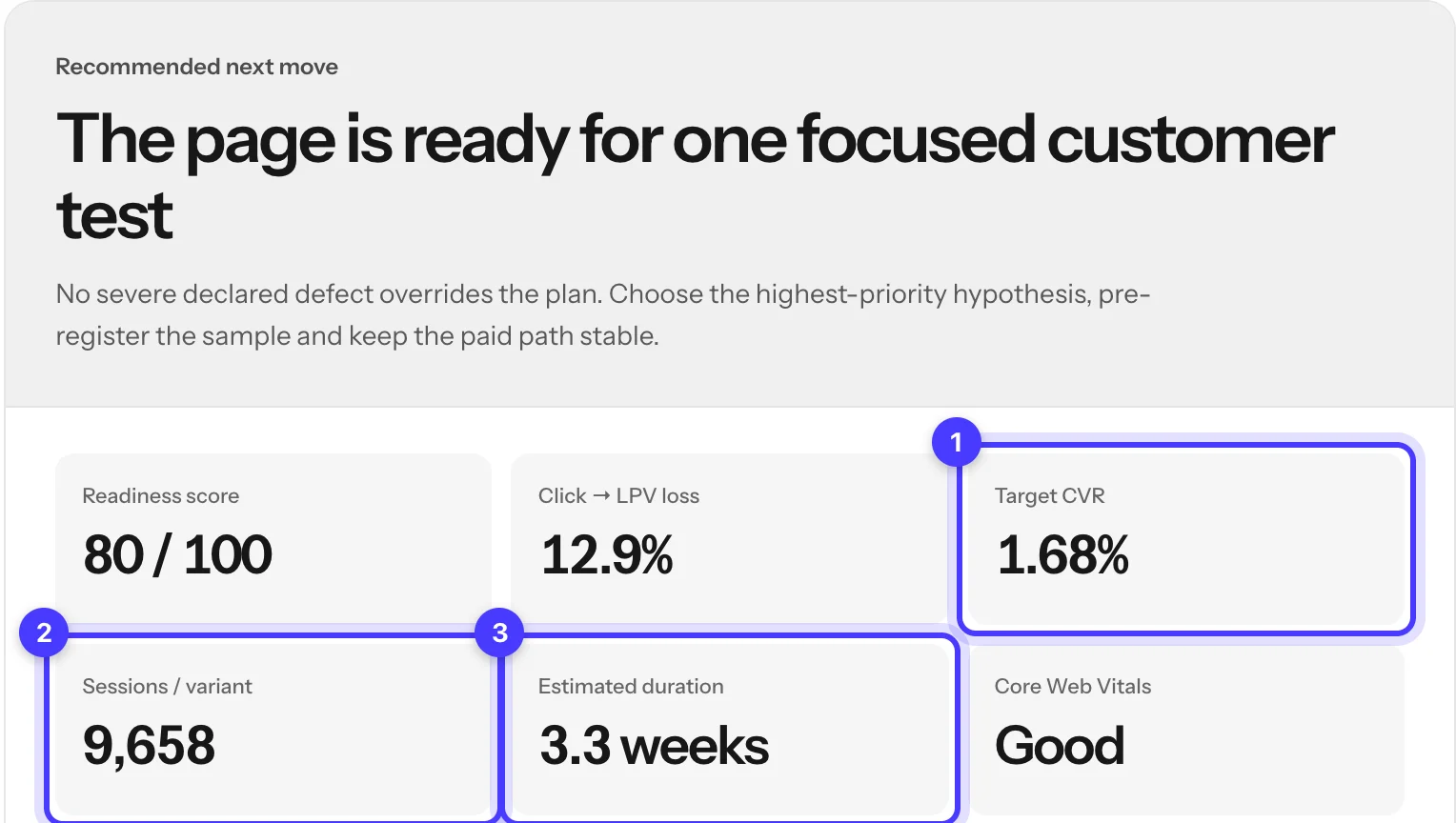
At 6,000 cold sessions a week split evenly, that is a little over three weeks. A smaller lift takes far longer to prove, which is why we test a whole new page against the product page rather than a new headline on day one.
How to test an advertorial against your product page
- Keep the ad identical. Same creative, same copy, same audience. Only the destination changes, or you are testing two things at once.
- Split visitors on the page side. Point the ad at one URL that sends half the visitors to the advertorial and half to the product page, using your landing page tool or testing app. Splitting by ad set lets Meta's delivery favour whichever ad it likes, so the two groups stop being comparable.
- Decide the sample before you start. Use the planner above, write down the sessions per page, and do not call it early because one side looks good on day three.
- Judge on purchases per session and cost per new customer. Not click-through, not time on page, not add to carts.
- Run across full weeks so weekday and weekend buyers are both in the sample, and keep sale periods out of the test.
If the planner flags problems first, fix those before testing. Its experiment queue usually lands on the same jobs an advertorial is built for.
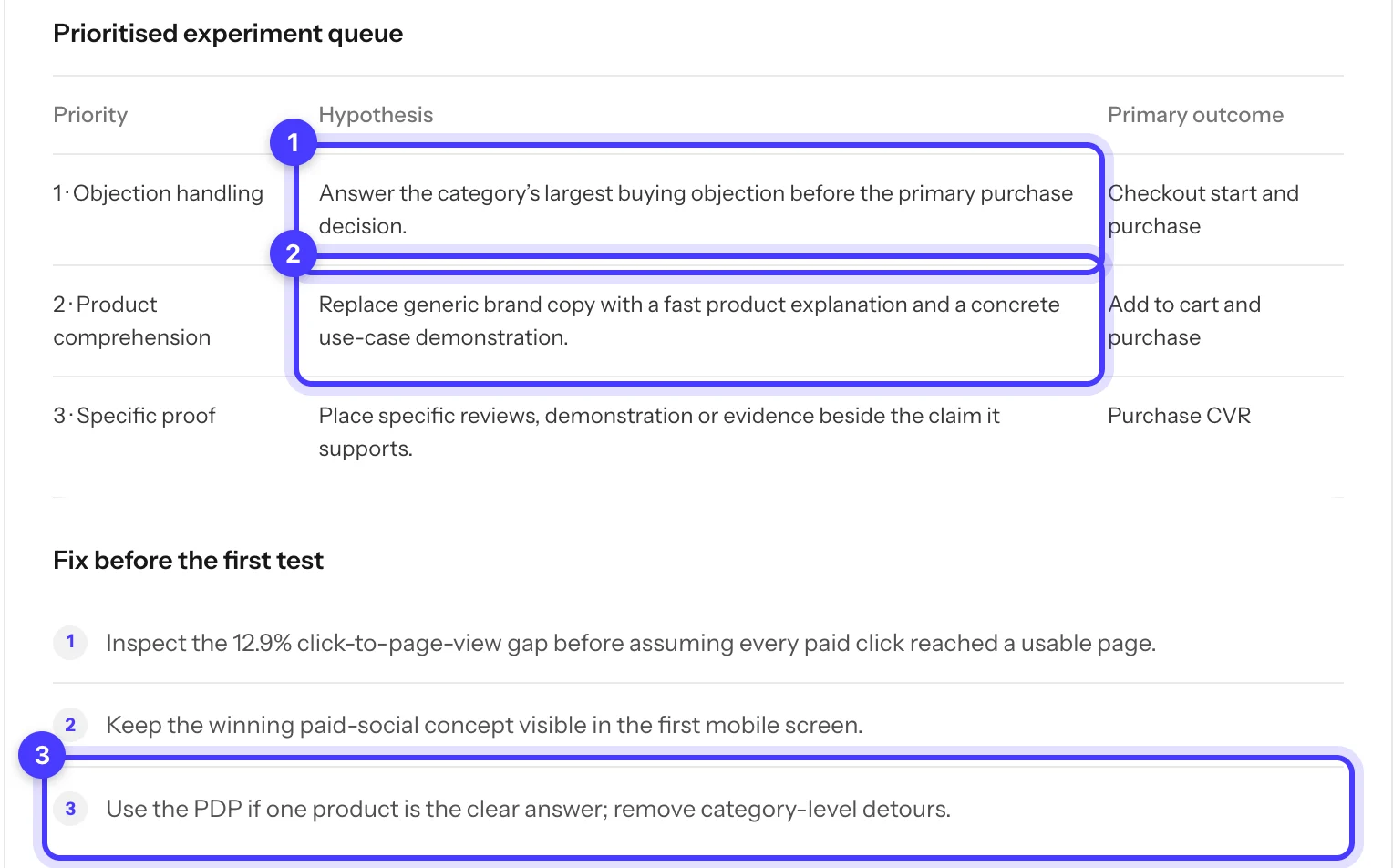
When the top items are objection handling and product explanation, an advertorial is the natural test. When the planner says one product is already the clear answer and the page simply needs to get out of the way, tighten the product page instead.
Advertorial mistakes we see most
- The fake publication. A made-up masthead, an invented journalist and a news-style logo. Policy risk, legal risk, and weaker results than brand voice.
- No button until the bottom. Readers who were sold by the ad should not have to scroll 2,000 words to buy.
- Claims with no proof under them. Every reason needs a review, a demonstration or a number from a real test beside it.
- Sending the click to the home page. The handoff goes to the product page, with the variant the reader was reading about already selected.
- Using it for warm traffic. Retargeting and branded searchers already know the product. Send them to the product page.
- Judging it on click-through. Measure orders and cost per new customer against the product page, over the sample you planned.
We build and test pages like this every month for the brands whose ads we manage. If you would rather hand the page and the test to us, our custom landing pages service covers both.
Questions we get about advertorial landing pages
What is an advertorial landing page?
It is a page between your ad and your product page that sells by explaining: usually a short numbered article in your brand's voice about why the product works and who it is for, with proof under each point and a button to the product page. The name comes from print ads written to look like editorial.
What is the difference between an advertorial and a landing page?
An advertorial is a type of landing page. A standard landing page leads with the offer and the buy box; an advertorial leads with the argument for the product and hands the reader to the product page or cart once they are convinced.
Are advertorial landing pages allowed on Meta and Google ads?
Yes, when they are honest. Meta prohibits falsely speaking in the voice of an established business or using a public figure's likeness without rights, and Google requires that ads are clearly ads and that destinations have original content. A page in your own brand voice with your logo, real reviews and claims you can back up is fine.
Do I need to label an advertorial as an ad in Australia?
The Marketing Association of Australia's Code of Ethics requires advertising to be clearly distinguishable as advertising. A page that is plainly your brand, with your logo and name in the header and selling your product in your voice, meets that. A page dressed as an independent news site does not, whatever small label it carries.
How long should an advertorial be?
Long enough to answer the questions that stop the first purchase and no longer. Ours usually take two to four minutes to read on a phone: five to seven reasons, an objection block, reviews and the offer, with a priced button in the first screen and again at the end.
How do I know if my advertorial is working?
Split visitors from the same ad between the advertorial and your product page, run the sample you planned in advance, and compare purchases per session and cost per new customer. Click-through from the advertorial to the product page is not the result; orders are.
Sources
- Meta Transparency Centre: Prohibited commercial practices (Community Standards)
- Meta Advertising Standards: Health and wellness
- Google Ads policies: Misrepresentation
- Google Ads policies: Destination requirements
- Marketing Association of Australia: Code of Ethics
- ACCC: False or misleading claims
- ACCC: Online reviews for products and services
- ACCC: Fines and penalties