
On this page
- 01 · Why your Meta CPM is high: the short answer
- 02 · How Meta sets the price of an impression
- 03 · When a high CPM is not your problem
- 04 · The seven usual causes of a high Meta CPM
- 05 · A 15-minute CPM diagnosis in Ads Manager
- 06 · What actually lowers CPM, and what does not
- 07 · CPM in the Australian sale calendar
- 08 · Is there a good CPM for Meta ads in Australia?
- 09 · Questions we get about high Meta CPMs
- 10 · Sources
Why your Meta CPM is high: the short answer
CPM is what you pay for 1,000 impressions: amount spent divided by impressions, multiplied by 1,000. Meta sets that price in an auction held every time it can show someone an ad, and the winner is the ad with the highest total value, which combines your bid, Meta's estimate of whether this person will take the action you optimise for, and ad quality. So your CPM rises for two reasons: more advertisers are competing for the same people (late November and December in Australia), or Meta predicts your ad is less relevant than the ads it is up against.
Before you try to lower it, check whether your cost per purchase or cost per lead actually moved. Meta's own guidance is that when you optimise for conversions, CPM may not be a good indicator of performance, because the system will buy pricier impressions when that gets you cheaper results. If CPA held steady, a higher CPM is the price of reaching buyers. If CPA rose with it, fix things in this order: creative relevance, audience overlap and fragmentation, audience and placement restrictions, then bid and cost controls.
How Meta sets the price of an impression
Meta's ad auction page describes three inputs to total value, plus a price floor that can affect whether your ad shows at all and what you pay:
- Bid: what you are willing to pay for your outcome. With the default highest volume strategy, Meta bids for you.
- Estimated action rates: the probability that showing this ad to this person leads to the result your ad set is optimised for.
- Ad quality: built from feedback such as people hiding the ad, and from assessments of low-quality attributes such as withheld information, sensationalised language and engagement bait.
Estimated action rates and ad quality together are what Meta calls relevance, and Meta states that an ad that is more relevant to a person can beat ads with higher bids. That is the whole lever: you rarely lower CPM by bidding less. You lower it by being the ad Meta expects people to respond to.
The GST detail Australian advertisers miss
The CPM in Ads Manager is calculated on amount spent before tax. Meta adds 10% GST on top of each charge for Australian advertisers who have not added an ABN to the ad account, so your real CPM is 10% higher than the column shows. Add your ABN in Payment settings and Meta stops adding GST to the charge. Either way, compare like with like: a CPM from Ads Manager against a CPM from Ads Manager, never against a figure that already includes tax. Our Meta ads cost guide for Australia covers the rest of the billing side.

Run Better Ads: our free ecommerce guide
We’ve tracked $700m+ in ad revenue across 200+ brands. See how we work out what a sale can cost and choose which ad to test next.
When a high CPM is not your problem
Cost per purchase is CPM divided by 1,000, divided by outbound CTR, divided by click-to-purchase conversion rate:
CPA = CPM ÷ (1,000 × outbound CTR × click-to-purchase CVR)
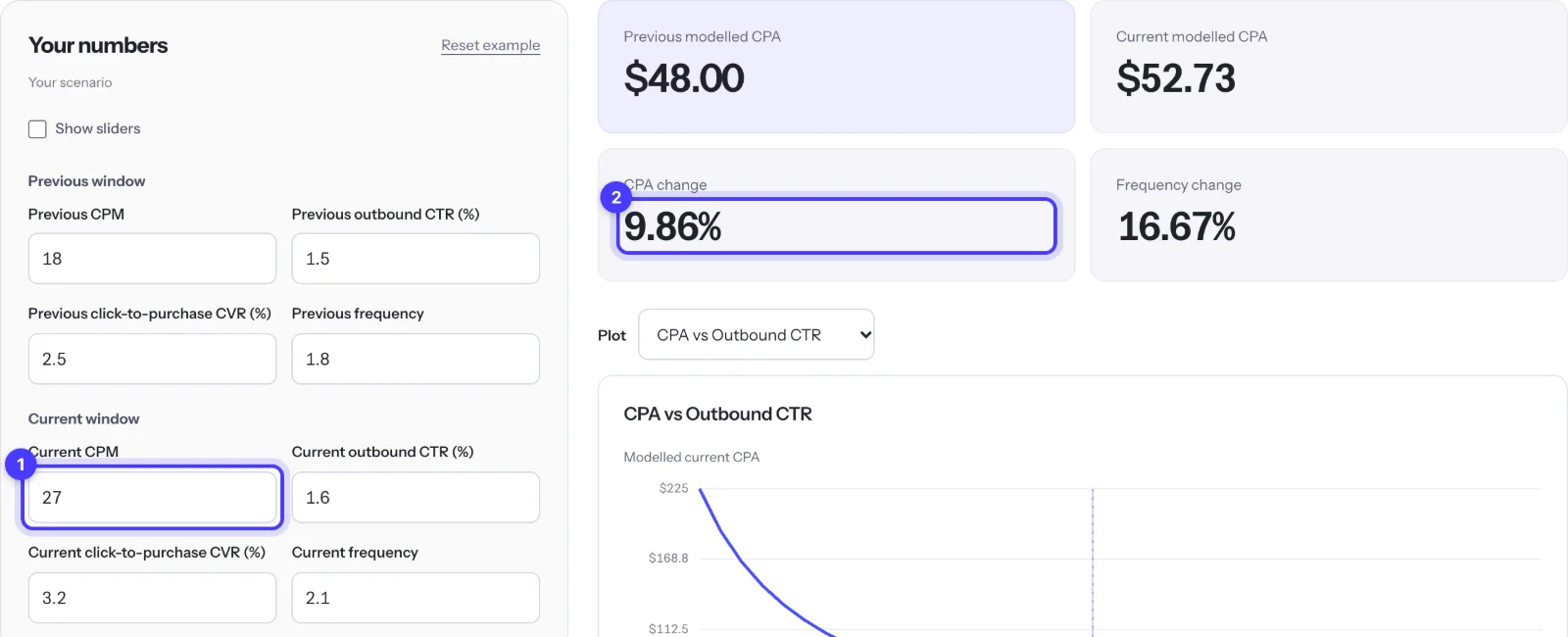
Worked example in AUD. In a normal week your CPM is $18, outbound CTR 1.5% and click-to-purchase conversion rate 2.5%. That is $18 ÷ (1,000 × 0.015 × 0.025) = $18 ÷ 0.375 = $48.00 per purchase. In sale week CPM jumps to $27, a 50% rise, but your sale offer lifts CTR to 1.6% and conversion rate to 3.2%. Now it is $27 ÷ (1,000 × 0.016 × 0.032) = $27 ÷ 0.512 = $52.73. CPA rose 9.86%, not 50%.
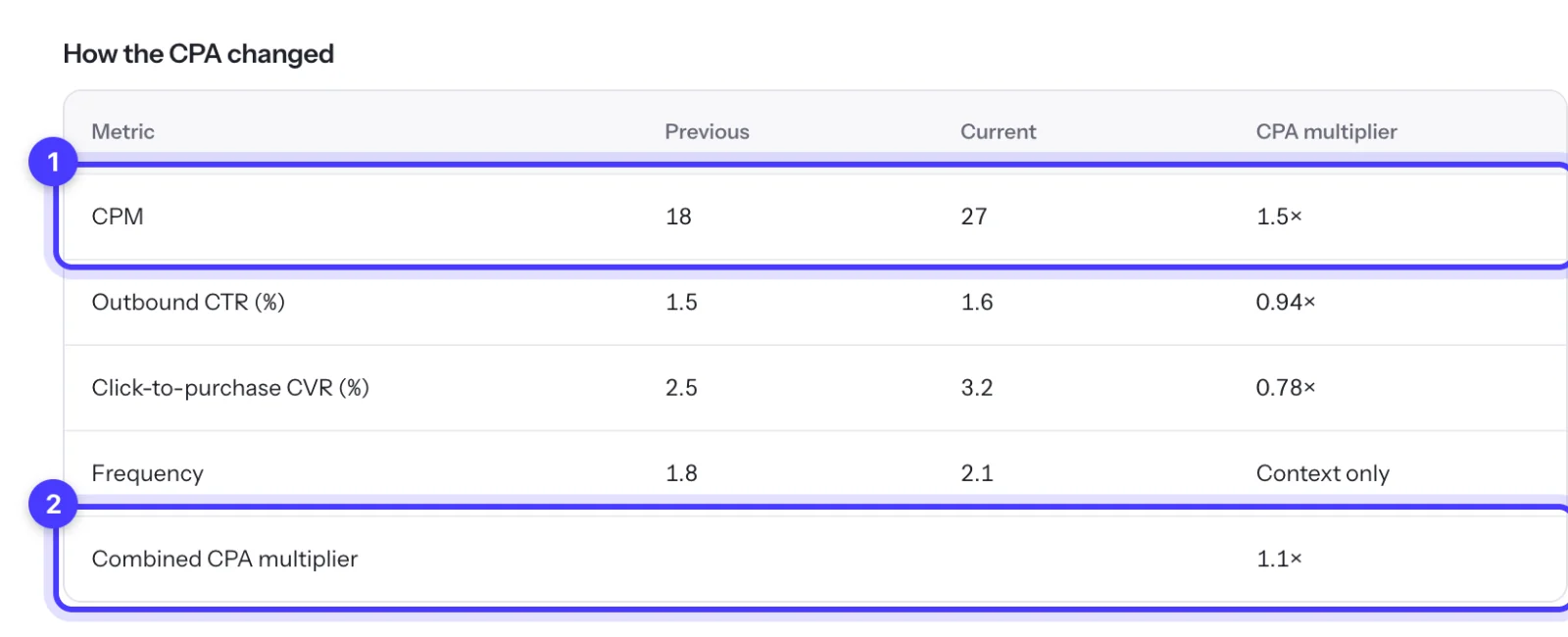
The three factors multiply. CPM pushes CPA up by 1.5 times, the better CTR pulls it down to 0.94 times and the better conversion rate to 0.78 times: 1.5 × 0.9375 × 0.78125 = 1.10. Adding the percentage changes instead (+50%, minus 6%, minus 22%) gives the wrong answer. Run your own two windows through our Meta Creative Fatigue Checker to see which factor actually moved.
Then hold the CPA against what you can afford, not against last month. If $52.73 still clears your break-even CPA, the higher CPM is simply what the auction costs this week. Our break-even ROAS guide shows how to work that number out with GST and margin included.
The seven usual causes of a high Meta CPM
| Cause | What you see | What to check |
|---|---|---|
| Sale-season competition | CPM up across every campaign in the same week, CTR steady | The calendar: Black Friday (27 November 2026), Cyber Monday (30 November), Christmas, Boxing Day, end of financial year in June |
| Weak relevance | One ad far pricier than others in the same ad set | Quality ranking, engagement rate ranking and conversion rate ranking below average |
| Creative fatigue | CPM creeping up week on week while frequency rises and link CTR falls | Frequency and link CTR over equal windows; see our frequency guide |
| Overlapping or fragmented ad sets | Several small ad sets on similar audiences, unstable costs, learning limited | Auction overlap recommendations under opportunity score in Account overview |
| A deeper optimisation event | Purchase-optimised ad sets cost more per impression than traffic or engagement ones | Nothing to fix: you are paying for people more likely to buy |
| Restricted placements or audience | Instagram-only or Reels-only ad sets, tight age or interest limits, small regional audiences | Placement and audience settings; breakdown by placement |
| Constrained delivery | Costs rising over the life of a campaign, bid or cost caps limiting spend | Bid strategy and caps; our bid cap vs cost cap guide |
On the last row, Meta explains that its delivery system takes the cheapest opportunities first, and when those run out it may move on to more expensive ones, depending on your bid strategy. A long-running ad set with a fixed audience will often show CPM climbing for that reason alone.
A 15-minute CPM diagnosis in Ads Manager
- Compare equal windows. Pick the last 7 days against the 7 before (or the same week last year in sale season), same campaigns, same attribution setting.
- Add the right columns. In Ads Manager, open Columns, then Customise columns, and add CPM (cost per 1,000 impressions), Frequency, CTR (link click-through rate), Cost per result, Quality ranking, Engagement rate ranking and Conversion rate ranking.
- Read the account first. If CPM rose by a similar amount on every campaign, it is the market. If it rose on one campaign or one ad, it is that campaign or ad.
- Read relevance at ad level. The three rankings compare your ad with ads competing for the same audience. Meta only shows them for ads with 500 or more impressions, and they report on past auctions rather than feeding into them, so use them to choose which ads to replace, not as a live score.
- Break down by placement and age. Under Breakdown, check By delivery, Placement. Expensive placements are not a problem if they bring cheap results; Meta optimises for the lowest average cost across all placements, not the lowest cost in each.
- Look for overlap. Check Account overview for an opportunity score recommendation about auction overlap. When two of your ads enter the same auction, Meta only lets the one with the highest total value compete, so overlapping ad sets starve each other rather than bid against each other.
- Do the arithmetic. Put both windows into the fatigue checker or the Meta Ads Performance Doctor to see whether CPM, click response or conversion moved CPA the most.
What actually lowers CPM, and what does not
What works
- New concepts, not new colours. Relevance is the lever Meta names. A different hook, angle or format (demonstration, comparison, founder, customer review) changes estimated action rates; a new button colour does not. Our guide on how many ad creatives to test sets the pace.
- Fewer, larger ad sets. Meta's own fixes for auction overlap are to combine similar ad sets and budgets, turn off the overlapping ones that are learning limited or have the fewest results, and consolidate across ad accounts. More results per ad set also gets you out of the learning phase sooner (see learning limited).
- Give delivery room. Broader audiences and Advantage+ placements give the system cheaper opportunities to choose from. In Meta's own placements example, turning off a placement with a higher cost per result raised the overall average cost. Supply 9:16, 4:5 and 1:1 versions of each asset so the ad fits every placement; our Meta ad sizes guide lists the spec for each one.
- Leave settled ad sets alone. Every significant edit restarts learning, and costs are usually worse while an ad set learns.
What does not
- Switching to a cheaper objective. Reach, traffic and engagement campaigns buy cheaper impressions because they are aimed at people less likely to buy. CPM falls; cost per purchase usually rises.
- Lowering a bid cap to force a lower price. The cap limits which auctions you win, so delivery shrinks before cost does.
- Duplicating the ad set. A copy aimed at the same people adds auction overlap, which is one of the causes above.
- Judging on one day. Meta may spend up to 75% over a daily budget on good days and less on others, and hourly or daily breakdowns swing. Judge CPM over a full week.
If you would rather have someone else run this check every week, it is exactly what our Meta ads management team does for Australian brands.
What makes an ad worth testing?
Explore 46 real ads and 17 landing pages. We break down the offer, the proof and what we’d try next.
CPM in the Australian sale calendar
Expect CPM to rise in the weeks when every retailer advertises at once: Black Friday and Cyber Monday (27 to 30 November 2026), the run into Christmas and Boxing Day, Click Frenzy and end of financial year sales in June. You cannot opt out of that competition, so plan around it:
- Build prospecting and warm audiences in the quieter weeks before the sale, when the same budget buys more reach.
- Set your sale-week target as a CPA you can afford at the discounted margin, not the CPM you paid in October.
- Launch sale creative a few days early so it is out of learning before the peak.
- Read results against the same week last year where you have it, not against the week before.
Our Black Friday budget and launch plan turns this into a day-by-day schedule.
Is there a good CPM for Meta ads in Australia?
Meta does not publish country-level CPM benchmarks, so every Australian figure you read is somebody's sample. The most useful benchmark is your own account: the same campaigns, the same season, last year. For context, our ecommerce ad benchmarks page interprets a public global cohort from Triple Whale's benchmark explorer: apparel and accessories brands turning over USD 1m to 10m a year, where the middle half of Meta CPMs sat between USD 8.48 and USD 21.32 from 14 April to 12 July 2026, and converts it to AUD. A CPM inside that range can still be too expensive for a low-margin product, and one above it can be fine for a high-value one. The test is always CPA against your break-even.
Questions we get about high Meta CPMs
What does CPM mean in Meta ads?
CPM is cost per 1,000 impressions: the amount spent divided by the number of impressions, multiplied by 1,000. In Ads Manager it appears as the CPM (cost per 1,000 impressions) column. It counts impressions, not people, so one person seeing your ad three times counts three times.
Why did my Meta CPM suddenly go up?
Check whether it rose on every campaign or only one. A rise across the whole account in the same week usually means more competition, which is normal in late November and December. A rise on one ad set usually means falling relevance (fatigue or a weak ad), overlapping ad sets or a change that restarted learning.
Does a high CPM mean my ads are bad?
Not on its own. Purchase-optimised campaigns pay more per impression because they target people more likely to buy, and sale periods cost more for everyone. It becomes a problem when CPM rises together with falling link CTR or conversion rate, which pushes cost per purchase up.
How do I lower my CPM on Meta?
Improve relevance with genuinely new creative concepts, combine overlapping ad sets, give delivery room with broader audiences and Advantage+ placements, and avoid frequent significant edits. Switching to a cheaper objective lowers CPM but usually raises cost per purchase.
Does Meta's CPM include GST in Australia?
No. Ads Manager reports spend before tax. If your ad account has no ABN, Meta adds 10% GST on top of each charge, so your real cost per 1,000 impressions is 10% higher than the column shows. With an ABN added in Payment settings, Meta does not add GST.
What is a good CPM for Meta ads in Australia?
Meta publishes no Australian benchmark. Use your own account history for the same season as the benchmark, and judge any CPM by whether your cost per purchase stays under your break-even CPA.
Sources
- Meta Business Help Centre: About ad auctions
- Meta Business Help Centre: Understand fluctuations in ad performance
- Meta Business Help Centre: About ad relevance diagnostics
- Meta Business Help Centre: Understand auction overlap
- Meta Business Help Centre: How the Meta delivery system works using Advantage+ placements
- Meta Business Help Centre: About Australia's goods and services tax (GST)