
On this page
- 01 · Can you bid on competitor brand names in Google Ads?
- 02 · What is allowed and what gets you in trouble
- 03 · Does bidding on competitor keywords pay?
- 04 · How to set up a competitor campaign
- 05 · When a competitor bids on your brand name
- 06 · The Australian cases in one place
- 07 · Questions we get about bidding on competitor keywords
- 08 · Sources
Can you bid on competitor brand names in Google Ads?
Yes. Google's trademark policy says it does not restrict the use of trademarks as keywords, so you can add a competitor's brand name to a Search campaign in Australia. In Veda Advantage v Malouf Group [2016] FCA 255, the Federal Court found that buying a competitor's mark as a keyword was not use as a trade mark, because searchers never see the keyword.
The risk starts the moment their name becomes visible. A competitor's brand in your headline or description can be restricted by Google after a complaint, and the same court found trade mark use where the mark appeared in sponsored link headings. Ads that make searchers think you are the brand they searched for can also breach the Australian Consumer Law: the advertisers in the Google v ACCC case were found to have misled people with exactly those headlines.
So the rule we work to is simple: their name in the keyword list, your name in the ad, your offer on the landing page. Then decide whether it pays, which is a separate question.
What is allowed and what gets you in trouble
Here is how each part of a competitor campaign sits against Google's policy and Australian law, checked against Google's trademark policy and the two leading Australian cases today.
| What you do | Google Ads policy | Australian law |
|---|---|---|
| Competitor brand as a keyword | Not restricted | Not trade mark use (Veda, 2016) |
| Competitor brand in a headline or description | Restricted for direct competitors once the owner complains | Can be trade mark use, and misleading if it suggests you are them |
| Keyword insertion that drops their name into your ad | Puts the term in your ad text, so the ad text rule applies | Same risk as writing it yourself |
| A fair, accurate comparison on your landing page | Not covered by the ad text rule | Allowed when accurate and like for like (ACCC) |
| A reseller or an information site naming the brand | Allowed when the page sells or reviews that product and says what you are | Allowed when it does not suggest you are the brand owner |
Two details trip people up. First, keyword insertion (the {KeyWord:...} syntax) writes the searched term into your headline, so a competitor ad group with keyword insertion puts their name in your ad. Turn it off in those ad groups. Second, Google's restriction works on complaints: an ad that runs today can be limited tomorrow when the owner files one, and the restriction usually covers every ad pointing at the same domain.
For comparative claims, the ACCC's test is that the comparison is accurate, compares like with like and stays true for as long as the ad runs. Keep the evidence for every claim.

Run Better Ads. The free guide + vault.
137 pages on ecommerce ads, with 46 real ads and 17 landing pages taken apart.
Does bidding on competitor keywords pay?
Usually less than people hope, and it is easy to measure, so treat it as a test with a cap. The cost comes from how Google rates the match between the search and your ad. Quality Score has three parts: expected click-through rate, ad relevance and landing page experience. Someone searching a competitor's name wanted that brand, so your expected click-through rate and ad relevance are rated low, and you pay more for each click than the brand owner does for the same search.
A worked example
Say your usual non-brand keywords cost $2.10 a click and convert at 3%, so each sale costs $70 in ad spend. On a competitor's name, the same example account pays $3.80 a click, because the clicks are scarcer and your relevance is lower, and converts at 1.5%, because many searchers were looking for the other store. Each sale now costs $3.80 / 0.015 = $253.
That only works if a new customer is worth well over $253 to you, after GST and product costs. Work out your ceiling first with our break-even ROAS guide or the COGS calculator, then compare it with what the test returns.
When it tends to work
- You have a clear, checkable difference the searcher cares about: price, delivery time, a feature, a warranty.
- The competitor has a known gap (stock, service, a discontinued product) and searchers are shopping around.
- Your customers buy again, so a high first-sale cost pays back over time.
- The competitor does not run its own brand campaign, so you are not up against a perfect Quality Score.
When none of those apply, the budget almost always does more on category searches. Our Google Ads strategy for 2026 covers where to put it first.
How to set up a competitor campaign
- Give it its own campaign. A separate campaign with its own daily budget keeps competitor clicks from eating the budget of campaigns that work, and keeps the reporting clean. Our Google Ads account structure guide shows where it sits next to brand, non-brand and Shopping.
- Use exact and phrase match. One ad group per competitor, with their brand name and its common misspellings. Broad match wanders into unrelated searches quickly here.
- Write about yourself. Your brand in the first headline, your offer and the reason to switch in the rest. Leave keyword insertion off.
- Send the click to a page built for it. A page that shows your offer and an honest comparison on the points you win converts far better than the homepage. Our guide to custom landing pages covers the build.
- Cap the spend and set a review date. Pick a budget you are happy to spend learning, and judge it on cost per new customer after two to four weeks, not on click-through rate.
- Watch the search terms report. Add negatives for job searches, login pages, support and anything else that is not a buyer.
If you do not want competitor searches at all, keep them out of your other campaigns. Brand exclusions in Google Ads stop a Search or Performance Max campaign serving on searches tied to brands you pick from Google's brand list, which saves adding every spelling as a negative keyword. Brand inclusions do the reverse for a Search campaign, limiting it to the brands you choose.
If you would rather hand the testing and the maths to someone who runs these every week, that is the kind of work we do in our Google Ads management.
When a competitor bids on your brand name
Most brands find out because their own name returns someone else's ad. Here is the order we work in.
- Run your own brand campaign. Your ads are the most relevant result for your own name, so your clicks are cheap and you take the top spot from a competitor who pays more for less. This alone fixes most cases.
- Find out who is bidding. Run auction insights on your brand keywords. For Search it reports impression share, overlap rate, position above rate, top of page rate, absolute top of page rate and outranking share for each domain in the same auctions. Then look up each domain in Google's Ads Transparency Center to see the ads they run.

- Check the ad text. If their ad only uses your name as a keyword, Google will not act. If your name appears in their headline or description, you can file a trademark complaint, and Google may restrict their use of it in ad text.
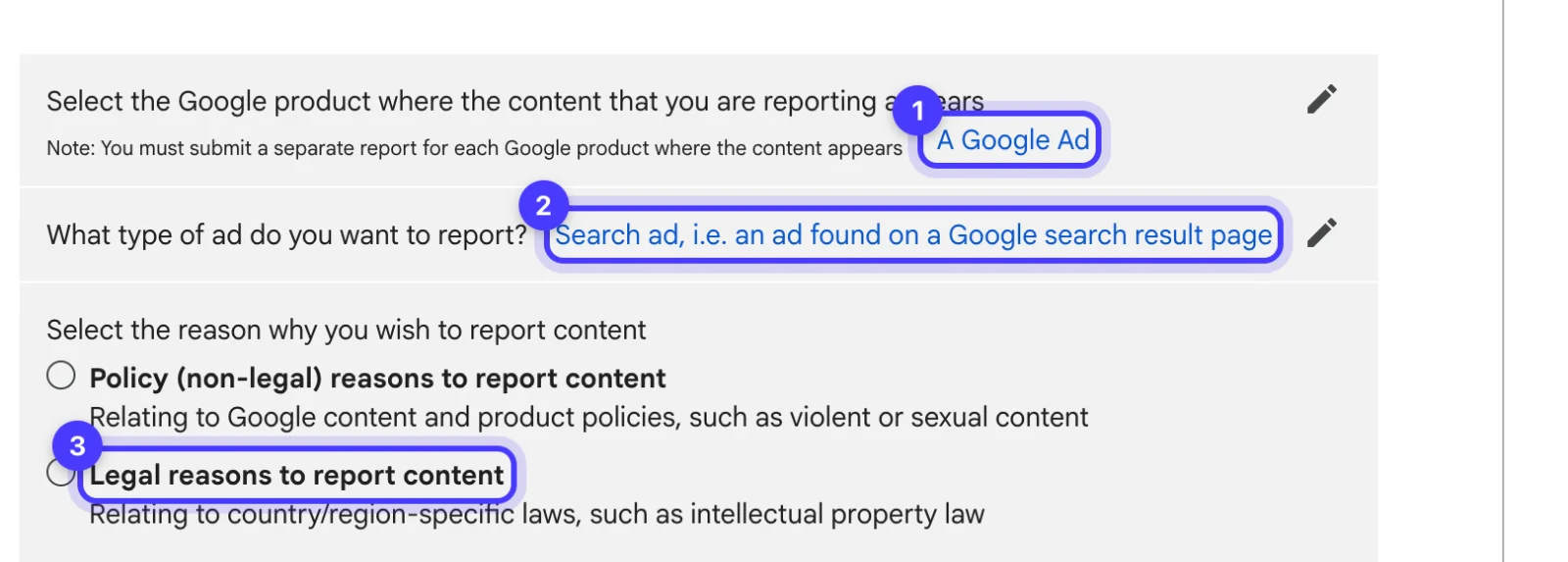
- File the complaint. Google's Report content on Google form takes you there: choose A Google Ad, then Search ad, then Legal reasons, and follow the trademark path. Google needs proof of your trade mark rights, so registered marks make this much easier. Name each advertiser by the URL its ads point to.
- Talk to resellers. When the bidder is a stockist, the fix is usually in your reseller terms: many brands agree brand-term rules and negative keywords in the reseller agreement.
- Escalate where the ad misleads. An ad that suggests the competitor is you may be misleading conduct or trade mark infringement. Get advice from a trade mark lawyer before you send a letter.
See the decisions behind real ads.
46 ad breakdowns and 17 landing pages, each with the next test it suggests.
The Australian cases in one place
- Google Inc v ACCC [2013] HCA 1. Sponsored links whose headlines used competitors' names, such as car dealers' names leading to a classifieds site, were found misleading. The High Court held that Google was not liable because it did not author the ads. The advertisers carry the responsibility for their ad text.
- Veda Advantage v Malouf Group [2016] FCA 255. Choosing a competitor's mark as a keyword was not use as a trade mark, because the keyword is not visible to consumers. Headings that presented the mark as the advertiser's own were trade mark use and misleading; headings that used it descriptively, in good faith, were not.
- Google's own policy sits on top: keywords are not restricted, ad text from direct competitors can be once the owner complains.
For tracking which campaign actually produced the sale, competitor campaigns included, our guide to why marketing revenue reports disagree explains the gaps between Google, GA4 and Shopify.
Questions we get about bidding on competitor keywords
Is it legal to bid on competitor keywords in Australia?
Bidding on a competitor's brand name as a keyword is allowed by Google, and the Federal Court found in Veda Advantage v Malouf Group (2016) that keyword use alone is not use as a trade mark because searchers never see it. Using their name in your ad text, or making an ad that suggests you are them, can be trade mark infringement or misleading conduct.
Can I use a competitor's name in my Google ad text?
Keep it out. Google restricts trademarks in ad text from direct competitors once the owner complains, and a competitor's name in your headline is the part Australian courts have treated as trade mark use or misleading. Write about your own brand and offer instead.
Why are competitor keywords so expensive?
Someone searching another brand's name wanted that brand, so Google rates your ad's expected click-through rate and relevance low, and you pay more per click than the brand owner. Fewer of those searchers buy from you, so the cost per sale is usually several times your normal non-brand cost.
How do I stop competitors bidding on my brand name?
You cannot stop them using it as a keyword. Run your own brand campaign so you hold the top spot at a low cost, check auction insights to see who bids, and file a trademark complaint with Google if your name appears in their ad text. For resellers, set brand-term rules in the reseller agreement.
Should I exclude competitor brands from Performance Max?
If you do not want to pay for competitor searches, yes. Brand exclusions stop a Performance Max or Search campaign serving on searches tied to the brands you choose, so run competitor bidding only as a deliberate test in its own Search campaign.
Sources
- Google Ads Policies: Trademarks
- Google Ads Help: About brand settings for Search and Performance Max
- Google Ads Help: About Quality Score for Search campaigns
- Google Ads Help: About auction insights
- Google Ads Transparency Center: FAQ
- High Court of Australia: Google Inc v Australian Competition and Consumer Commission [2013] HCA 1
- IPTA: Federal Court rules on trade marks as keywords (Veda Advantage v Malouf Group [2016] FCA 255)
- ACCC: False or misleading claims