
On this page
- 01 · ABO vs CBO: the short answer
- 02 · The three budget strategies Meta offers in 2026
- 03 · A worked example: why CBO is the wrong tool for a creative test
- 04 · How to set up each option in Ads Manager
- 05 · Rules and limits that catch people out
- 06 · Campaign budget with bid caps and cost goals
- 07 · The structure we use for Australian ecommerce accounts
- 08 · Mistakes we see
- 09 · Questions we get about ABO and CBO
- 10 · Sources
ABO vs CBO: the short answer
ABO (ad set budget optimisation) means each ad set has its own budget. CBO (campaign budget optimisation) means one budget at campaign level that Meta moves between ad sets in real time. Meta now calls CBO Advantage+ campaign budget, shown in Ads Manager simply as Campaign budget, and it is switched on by default for sales, leads and app promotion campaigns.
Our rule: use campaign budget once you are scaling ad sets that you value equally and you judge results at campaign level. Use ad set budgets when each ad set must get a known amount of spend: creative tests, a new market, a retargeting pool far smaller than your prospecting audience, or ad sets with different bid strategies. There is now a middle option, ad set budget sharing, which keeps ad set budgets but lets Meta move up to 20% of each one to where results are cheaper. For most Australian stores we test on ad set budgets with sharing on, then move winners into a campaign budget to scale.
The three budget strategies Meta offers in 2026
Meta's help centre lists three, not two:
| Strategy | Old name | How spend moves | Best for |
|---|---|---|---|
| Advantage+ campaign budget | CBO | One campaign budget, distributed in real time to the ad sets with the best opportunities. It may spend most of the budget on one ad set. | Scaling proven ad sets you value the same, judged at campaign level |
| Ad set budget sharing | None (new) | Each ad set keeps its own daily budget; up to 20% of it can move to other ad sets in the campaign | Tests that need a minimum spend per ad set, with some efficiency on top |
| Ad set budgets | ABO | Each ad set spends its own budget as delivery opportunities appear | Strict control per ad set, mixed bid strategies or optimisation goals, very different audience sizes |
Budget sharing only works with daily budgets, needs at least two active ad sets on the same bid strategy, and Meta's developer documentation says it cannot be switched on for a campaign that is already running, so decide at launch. The only time an ad set gives away more than 20% is when it cannot deliver its own budget, for example because its audience is too small.

Run Better Ads. The free guide + vault.
137 pages on ecommerce ads, with 46 real ads and 17 landing pages taken apart.
A worked example: why CBO is the wrong tool for a creative test
Say your break-even cost per purchase is $60 (work yours out with our break-even ROAS guide), and you want to test three new creative angles for a week on $150 a day, one angle per ad set.
| Setup | Least an angle can get in 7 days | Enough to judge it? |
|---|---|---|
| Ad set budgets: $50 each | About $350 (daily spend varies, the week averages out) | Yes. $350 is almost 6 break-even purchases' worth of spend |
| Ad set budgets with sharing: $50 each | About $280 (80% of $50 x 7) | Yes. Almost 5 purchases' worth, and the stronger angles get the extra |
| Campaign budget: $150 | No floor. Meta can put $900 of the $1,050 into one angle and $50 into another | No. $50 is less than one purchase, so the angle is never really tested |
A campaign budget is designed to do exactly this: it finds the cheapest results first, which is efficient for scaling and unhelpful for a test. Meta's own guidance says to analyse campaign budget results at campaign level, not per ad set. If you need a verdict on each ad set, give each one a budget. Our guide to how many ad creatives to test covers how many angles a budget like this can carry.
How to set up each option in Ads Manager
- Click Create, choose your objective and click Continue.
- At campaign level, find Budget, then Budget strategy.
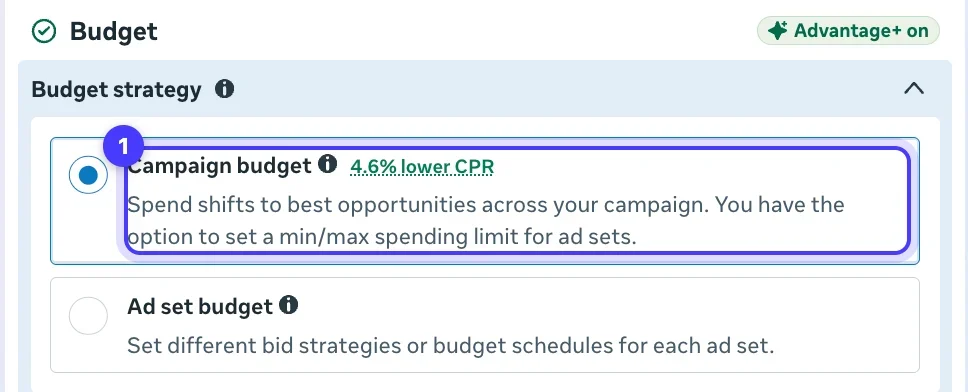
- Choose Campaign budget for CBO, then pick Daily budget or Lifetime budget and the amount, and choose the Campaign bid strategy. Our guide to daily vs lifetime budgets explains that choice.
- Or choose Ad set budget for ABO. You then set the budget and bid strategy inside each ad set, and on a daily budget you can turn on budget sharing between ad sets.
To use a campaign budget, every ad set in the campaign must share the same budget type (all daily or all lifetime), the same bid strategy, the same optimisation event if the strategy is Highest volume, and standard delivery. Choosing ad set budgets in a sales campaign also turns the budget section to Advantage+ off, which is fine; Meta says the rest of the campaign can still use Advantage+ audience and placements, as we explain in is Meta Advantage+ worth it.
Rules and limits that catch people out
| Rule | What Meta says | What to do |
|---|---|---|
| Switching on or off | A 2 hour minimum applies between turning campaign budget on and off | If you need ad set budgets sooner, pause the campaign and build a new one |
| Ad sets per campaign | Campaign budget allows more than 70 and up to 200 ad sets, but above 70 you cannot change the bid strategy or turn campaign budget off after publishing | Stay under 70. More ad sets also means longer in the learning phase |
| New ad sets | About 2 hours for the campaign budget to readjust each time you add one | Add new ad sets in batches, not one a day |
| Pausing ad sets | Pausing removes an ad set from the budget; when you unpause it, there may be nothing left to spend | Do not pause and unpause to steer spend. Fix delivery, or use spend limits |
| Ad set spend limits | Set under Budget & schedule, Ad set spending limits, as a % or a $ amount. A maximum is managed across the Sunday to Saturday week, so one day can run over it. A minimum is a target Meta aims for, and a cost per result goal or bid cap makes it harder to reach. Meta advises against both on one ad set, and switching to ad set budgets resets them | Use a minimum only to protect a small ad set, such as a new market; if every ad set needs a floor, use ad set budgets |
| Audience size | The largest audiences usually receive the most budget | Keep a small retargeting pool in its own campaign on its own budget |
| Daily spend | Up to 75% over the daily budget on a good day, never more than 7 times it in a week | Read spend weekly, not daily |
One more: Meta blocks cost-based automated rules that pause or alert on ad sets or ads inside a campaign using Advantage+ campaign budget. If your account relies on stop-loss rules at ad set level, those ad sets need their own budgets.
Campaign budget with bid caps and cost goals
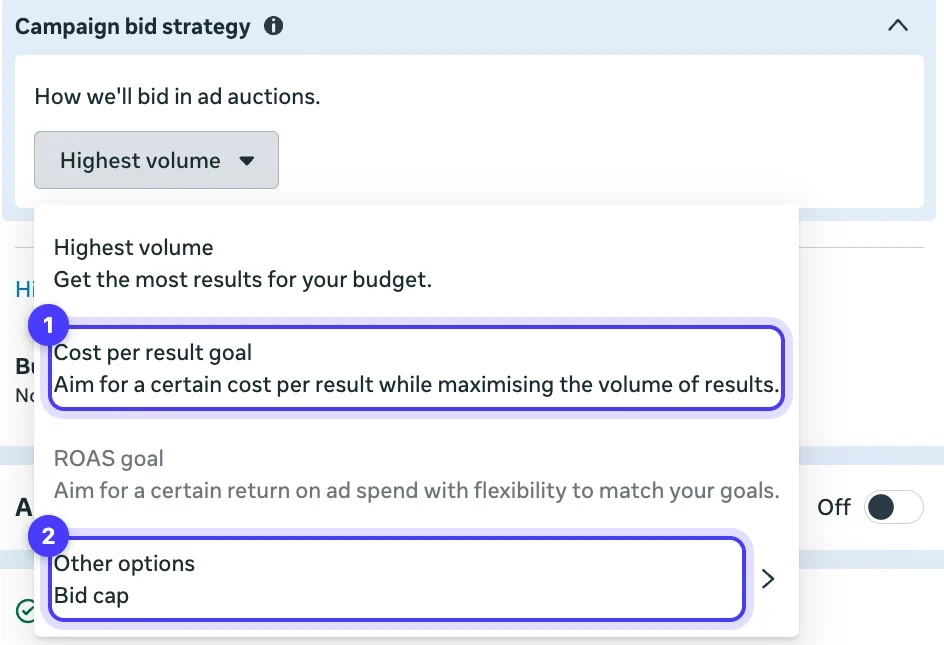
With a campaign budget the bid strategy lives at campaign level, so every ad set bids the same way. That suits a scaling campaign on a Cost per result goal set from your break-even number: Meta moves spend to whichever ad set can hit it. It does not suit ad sets that need different targets, such as prospecting at a $60 goal and retargeting at $35; that is the case Meta itself gives for ad set budgets (mixed bid strategies). Our bid cap vs cost cap guide shows how to set the number. Be careful stacking a bid cap with ad set minimums: Meta warns too many constraints can stop an ad set delivering at all.
See the decisions behind real ads.
46 ad breakdowns and 17 landing pages, each with the next test it suggests.
The structure we use for Australian ecommerce accounts
- Scaling campaign: campaign budget. Proven creative, broad Advantage+ audience, two to five ad sets at most, judged on campaign cost per purchase or ROAS. We plan the monthly spend in our ad budget pacing planner before setting the daily figure.
- Testing campaign: ad set budgets with sharing on. One ad set per angle or offer, equal daily budgets, run for at least seven days, graduates moved into the scaling campaign.
- Separate campaigns only for real differences: a second country, a small retargeting pool or a sale with its own budget. The rest of our thinking on this is in the Meta ads account structure guide.
If you would rather we set this up and run the tests for you, that is how we manage Meta ads for Australian brands.
Mistakes we see
- Testing creative in a campaign budget, then calling the angles Meta never spent on losers.
- Judging a campaign budget ad set by ad set. An ad set with a higher cost per result can still be the one producing the cheapest extra results; look at the campaign total.
- Mixing a 5,000 person retargeting audience with a broad prospecting ad set under one campaign budget, then wondering why retargeting gets almost nothing.
- Switching back and forth. A switch usually changes the bid strategy too, and Meta counts a bid strategy change as a significant edit that sends ad sets back into the learning phase. Under a campaign budget, a new campaign bid strategy or a large budget change can restart learning for several ad sets at once. Adding an ad set does not reset the others, and Meta moving budget between ad sets never does.
- Too many ad sets on a small budget. On $100 a day, ten ad sets in a campaign budget means most never leave learning.
Questions we get about ABO and CBO
What do ABO and CBO stand for?
ABO is ad set budget optimisation: each ad set has its own budget. CBO is campaign budget optimisation: one budget at campaign level that Meta distributes across the ad sets. Meta now calls CBO Advantage+ campaign budget, and Ads Manager labels it Campaign budget.
Is Advantage+ campaign budget the same as CBO?
Yes. Advantage+ campaign budget is Meta's current name for campaign budget optimisation. Meta's help centre also calls it campaign budget or budget with Advantage+ on.
Is ABO or CBO better for testing?
ABO, ideally with ad set budget sharing on. A campaign budget can spend most of the money on one ad set, so the others may never get enough spend to judge. Ad set budgets give each test a known amount; sharing still lets up to 20% move to the stronger ad sets.
What is ad set budget sharing in Meta ads?
An option for campaigns on ad set budgets that lets Meta move up to 20% of each ad set's daily budget to other ad sets in the same campaign when they have better opportunities. It needs daily budgets, at least two active ad sets and the same bid strategy across them, and it is set when the campaign launches.
Can I switch a campaign from CBO to ABO?
Yes, by switching the budget strategy to ad set budget and giving each ad set a budget, but there is a two hour minimum between turning campaign budget on and off, and campaigns with more than 70 ad sets cannot turn it off after publishing. If the switch also changes the bid strategy, Meta treats it as a significant edit and the ad sets re-enter the learning phase.
Do ad set minimum spend limits guarantee spend?
No. Meta treats minimum and maximum ad set spend limits under a campaign budget as a best effort target and recommends using them sparingly. If every ad set needs a guaranteed amount, use ad set budgets instead.
Sources
- Meta Business Help Centre: About campaign budgets and ad set budgets
- Meta Business Help Centre: About Advantage+ campaign budget
- Meta Business Help Centre: Set up Advantage+ campaign budget
- Meta Business Help Centre: Best practices for Advantage+ campaign budget
- Meta Business Help Centre: Understand Advantage+ campaign budget results
- Meta Business Help Centre: About ad set spend limits with campaign budget
- Meta Business Help Centre: Significant edits and learning phase
- Meta for Developers: Ad set budget sharing
- Meta for Developers: Advantage campaign budget